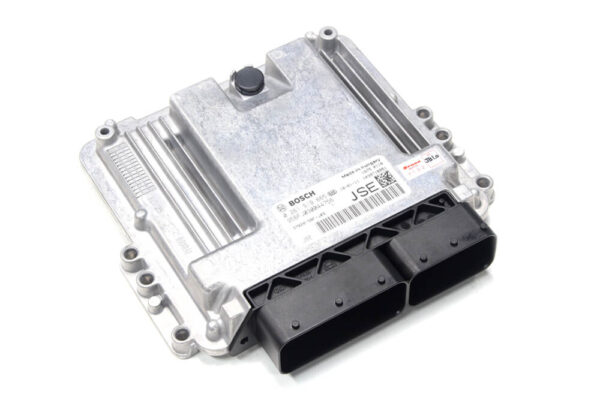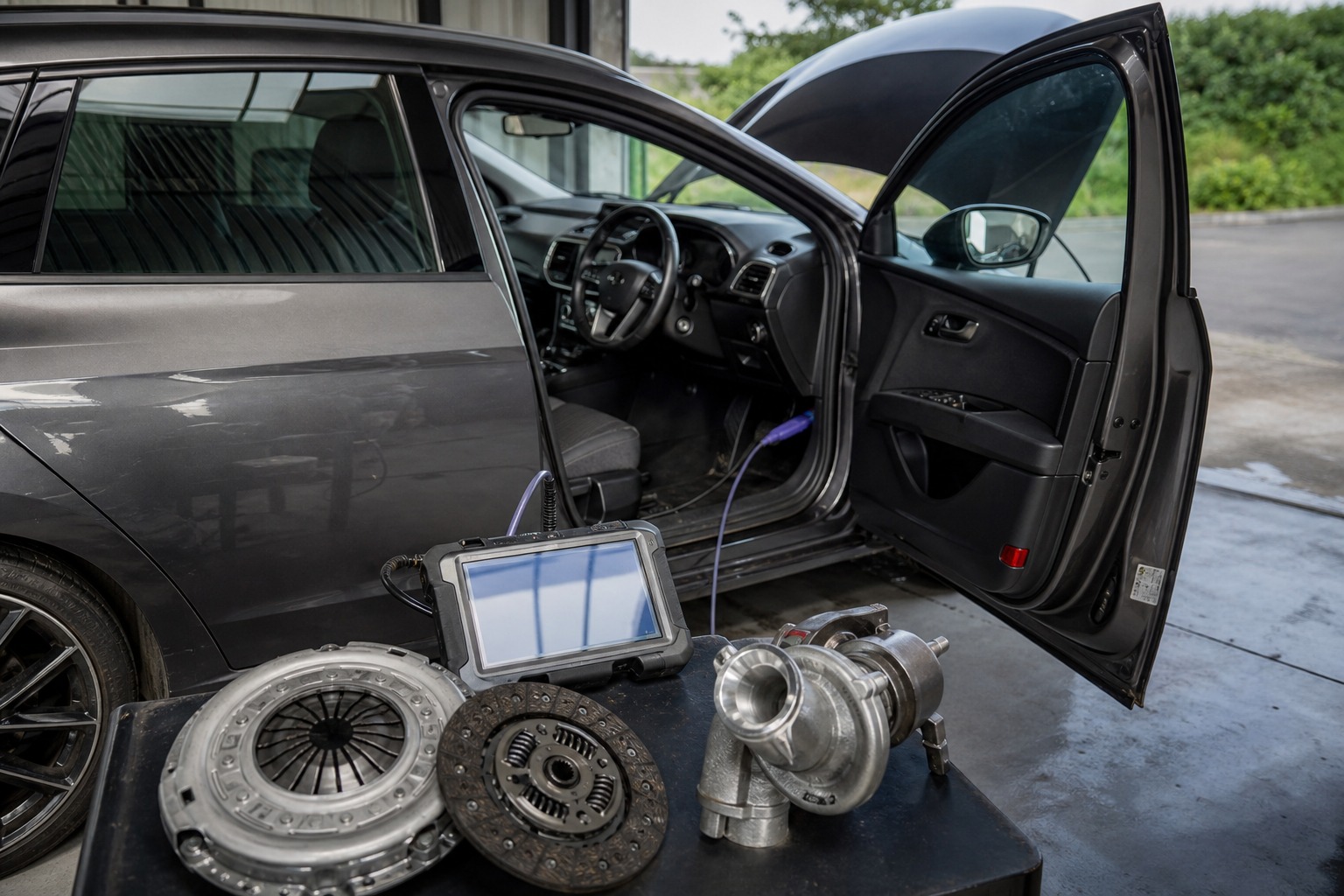
Usually, you should wait until the repair has been completed, checked and proven before remapping. A manual clutch may need a manufacturer-specified bedding-in period. A replacement turbo needs correct installation and confirmation that the fault which damaged the original unit has been addressed. Some DSG or dual-clutch repairs also require model-specific basic settings or an adaptation drive.
There is no universal answer such as “wait 500 miles”. The correct timing depends on the exact clutch or turbo fitted, the vehicle manufacturer’s repair procedure and how the vehicle behaves afterwards.
Pause and return to the repairer first if the vehicle has clutch slip or judder, difficult gear selection, abnormal pedal behaviour, warning lights, limp mode, recurring fault codes, smoke, unusual turbo noise, leaks or poor drivability. A remap should not be used to work around an unresolved mechanical problem.
Bedding-in, repair sign-off and remap suitability are different checks
These three stages are often treated as one, but each answers a different question:
| Stage | What it establishes | What it does not establish |
|---|---|---|
| Bedding-in | Where required, the clutch friction surfaces have been used according to the part maker’s instructions. | That the installation is fault-free or the clutch is suitable for a particular calibration. |
| Repair sign-off | The replaced system operates normally, with applicable checks and procedures completed. | That the entire vehicle is automatically ready for increased load. |
| Remap assessment | The vehicle’s condition, replacement parts, diagnostics and intended use can be considered together. | A guaranteed outcome based only on the fact that new parts have been fitted. |
A cleared warning light, completed installation or MOT pass is not, by itself, proof that a vehicle is ready for increased load. Remap suitability should be considered only after the underlying repair is behaving normally.
After a manual clutch replacement: follow the exact clutch instructions
Start with the repair invoice and identify the clutch-kit part number, flywheel arrangement and any other parts replaced. Then obtain the written bedding instructions for that specific product.
Different clutch manufacturers and product ranges publish different requirements. For example, instructions for some performance clutch products specify a period of ordinary, low-to-mid-rev driving while avoiding launches, rapid shifts and wide-open-throttle use. The distances also vary. That is why advice intended for one clutch must not be applied automatically to another.
The clutch manufacturer’s instructions and the applicable vehicle repair information should take priority over a generic remapping timetable. If no instructions were supplied, ask the fitting garage or parts supplier to confirm the correct procedure rather than choosing an arbitrary distance.
Bedding-in allows applicable friction surfaces to mate under controlled use. Aggressive driving too early can create excessive heat, and clutch manufacturers warn that this may contribute to glazing, shudder, slip or reduced effective capacity. This does not mean a remap will inevitably damage a new clutch. It means high-load use should wait until any required bedding process and post-repair checks are complete.
Manual-clutch sign-off checklist
- The invoice identifies the exact clutch, flywheel and associated parts fitted.
- The product maker’s bedding instructions have been found and completed where applicable.
- The pedal behaves normally and consistently.
- Gears select normally when the vehicle is cold and warm.
- There is no slip, judder, unusual noise or persistent burning smell.
- The vehicle drives normally under the loads permitted during its bedding period.
- Any concern raised after installation has been checked by the repairing garage.
Do not assume that a clutch is suitable for Stage 1 or Stage 2 simply because it is described as “uprated”. Holding ability depends on the exact components, installation, vehicle and operating conditions. Generic torque-capacity figures are not a sound basis for deciding suitability.
If you are uncertain whether a symptom is clutch slip, read Can a Remap Cause Clutch Slip? Signs, Causes and Sensible Checks. Diagnosis should come before further tuning.
After a DSG or DCT clutch-pack replacement: adaptation is conditional
A dual-clutch gearbox repair should not be treated as equivalent to replacing a conventional manual clutch. For certain vehicles and repairs, the manufacturer procedure requires basic clutch settings and may also specify an adaptation drive. Other vehicles and repair types may have different requirements.
There is no universal reset or relearn process for every DSG, DCT or automatic transmission. Confirm with the repairing garage that it followed the correct manufacturer procedure for the exact gearbox and work carried out. Where basic settings or adaptation are specified, they should be completed successfully before remapping is considered.
Relevant engine or transmission faults also need attention. Some manufacturer procedures require the affected control modules to be free from faults before basic settings can be performed. Simply deleting a code does not demonstrate that its cause has been fixed.
After turbo replacement: prove the whole system, not just the new unit
A newly fitted turbo is not automatically ready for increased load. Turbo manufacturer Garrett explains that turbo damage can be a symptom rather than the root cause. If the original cause remains, fitting another unit may not resolve the wider problem.
Before tuning, the repairing garage or an appropriately equipped technician should have considered the relevant system around the turbo. Depending on the vehicle and failure, professional checks may include:
- Why the original turbo failed.
- The condition and suitability of the oil supply and drain arrangements.
- Intake and charge-air pipework.
- Air, oil, gas and exhaust leaks.
- Exhaust restrictions, including relevant catalyst or DPF concerns.
- Crankcase pressure, breather function and related oil-control issues.
- Fuel-injection issues where relevant to the original symptoms.
- Correct actuator operation on systems where an actuator is fitted.
These are professional repair and diagnostic considerations, not DIY instructions. The precise procedure comes from the vehicle manufacturer and the turbo supplier. There is also no well-supported universal “turbo run-in mileage” that can replace these checks.
What normal turbo operation should look like before remapping
The vehicle should behave consistently when cold and at normal operating temperature, without unresolved warning signs. Return it to the repairing garage if you notice:
- An engine-management or other relevant warning lamp.
- Limp mode, poor power or inconsistent power delivery.
- Active or recurring fault codes.
- Reported boost deviation.
- A new hissing sound or unusual whistle.
- Smoke or an unexplained oil-consumption concern.
- Oil, air, fluid or exhaust leaks.
- Abnormal noise or drivability following the repair.
These symptoms are reasons to pause, not a diagnosis of turbo failure. A hissing noise or lost power can have several causes; our guide to boost-leak diagnosis explains why the wider air path matters.
Likewise, clearing a fault code and seeing whether it returns is not proof that a repair is complete. If a warning lamp remains, see whether a car should be remapped with an engine-management light on.
A seven-step pre-remap sign-off sequence
- Identify the repair. Retain the invoice and establish exactly which clutch, flywheel, turbo and related parts were fitted.
- Complete applicable bedding. For a clutch, follow the instructions for that exact product rather than a mileage quoted for another part.
- Confirm required procedures. Ask whether manufacturer-specified basic settings, calibration steps or adaptation drives applied and were completed.
- Prove everyday operation. Confirm that the vehicle behaves normally both cold and hot, within the use permitted by any bedding instructions.
- Resolve faults properly. Active or recurring codes, warning lamps and limp mode need diagnosis. Code deletion alone is not repair verification.
- Investigate symptoms. Do not proceed with unexplained slip, judder, smoke, leaks, oil-use concerns, noises or inconsistent power.
- Discuss calibration suitability. Only after the earlier steps are satisfied should the exact vehicle, parts and intended use be assessed for Stage 1 or Stage 2.
Completing this sequence means the vehicle may be ready to discuss; it is not a guarantee that a particular calibration will be suitable. For a wider assessment, use our Stage 1 pre-booking health check.
What to tell a remapping provider before booking
A useful pre-booking conversation should include more than “it has a new clutch” or “the turbo has been changed”. Be ready to provide:
- The vehicle registration and relevant vehicle details.
- The engine and gearbox type, if known.
- What failed and what work the garage carried out.
- The exact replacement clutch or turbo specification and part number, where available.
- The repair date and use since the repair.
- Any written bedding instructions and whether they have been completed.
- Whether required gearbox basic settings or adaptation were completed.
- Current and recent warning lights or diagnostic fault information.
- Any remaining change in noise, smoke, oil use, gear selection or drivability.
An accurate repair history is more useful than requesting a predetermined map outcome. It helps separate a proven mechanical repair from a vehicle that still requires diagnosis.
Insurance, warranty and emissions considerations
Before remapping, check your insurance policy and ask your insurer what must be disclosed. You should also review the vehicle warranty and the terms supplied with the replacement clutch, turbo and fitting work. Outcomes vary, so do not assume that either the repair or a later ECU calibration will be covered.
For a UK public-road vehicle, tuning should not be used to remove, bypass or defeat required DPF, GPF, catalyst, EGR or SCR/AdBlue functions. An emissions-system fault should be diagnosed and repaired lawfully. A replacement turbo can also have connections with oil contamination, exhaust restriction or emissions-system symptoms, so those concerns should not be hidden by software changes.
Discussing your vehicle with Swansea Remaps
Swansea Remaps provides fully mobile ECU diagnostics and Stage 1 and Stage 2 remapping across Swansea and the stated surrounding South Wales service areas, including Neath, Port Talbot, Llanelli, Gorseinon, Morriston, Mumbles, Pontarddulais and Ammanford.
Before booking, share the work completed, exact parts fitted, bedding or adaptation status and any current symptoms or warning lights. ECU diagnostics can support fault assessment, but Swansea Remaps does not provide mechanical repairs or dyno testing, and suitability cannot be guaranteed remotely.
The practical answer is simple: do not remap merely because the new part has been installed. Complete the relevant bedding or adaptation procedure, prove that the repair works correctly, resolve faults and then assess Stage 1 or Stage 2 suitability for the individual vehicle.
Sources & further reading
External references used to support factual points in this guide.
- www.gov.uk
- www.garrettmotion.com
- www.gov.uk
- www.gov.uk
- www.gov.uk
- Regulating environmental impact of in-use emissions of road vehicles - GOV.UK
- www.gov.uk
- www.gov.uk
- www.legislation.gov.uk
- www.gov.uk
- www.gov.uk
- www.nidirect.gov.uk
- www.gov.uk
- www.legislation.gov.uk
- assets.publishing.service.gov.uk
- assets.publishing.service.gov.uk
- uk-air.defra.gov.uk
- manticclutchusa.com
- clutchindustries.freshdesk.com
- uniclutch.com
Results, compatibility and suitable options vary by vehicle, software version, mechanical condition and existing modifications. Always confirm the correct route for your own vehicle before work is carried out.