Usually, no: a car with an engine management light (EML) should be diagnosed before it is remapped. A steady light means diagnose first; a flashing light, severe symptoms or major loss of power means stop safely where appropriate and seek repair or recovery. If a historic fault has been repaired and checks show no active issue, remapping may still be considered.
An EML can have many causes, from fuelling, boost, ignition and air-measurement faults to exhaust after-treatment or control-unit communication problems. A remap changes ECU calibration; it does not repair an underlying fault or make a warning safe to ignore. The sensible sequence is to establish what the vehicle is reporting, repair or refer the underlying problem where necessary, then revisit the tuning decision.
Any ECU calibration change should also be disclosed to your insurer, and the vehicle must remain compliant for lawful road use. If you are unsure whether the warning is relevant to engine operation, start with ECU diagnostics rather than booking a remap on the assumption that the light is unrelated.
Why an engine management light matters before remapping
The EML, also called the malfunction indicator lamp (MIL), is intended to alert the driver to an engine-management or emissions-related malfunction. It does not identify the failed part by itself. A diagnostic trouble code is a starting point: it records the system and condition that caused the ECU to set the code, but further checks may be needed before deciding on a repair.
That distinction matters when tuning is being considered. If the car already has an air leak, inconsistent fuel delivery, weak ignition, implausible sensor reading, turbo-control issue or exhaust-system fault, changing the ECU calibration first can make the overall picture less clear. It may also mean the vehicle cannot deliver power consistently or safely enough for the intended calibration.
For this reason, a responsible remapping decision should be based on the vehicle’s actual condition, not solely on whether it drives reasonably on a short journey. If you are unsure whether the warning is related to engine operation, start with ECU diagnostics rather than booking a remap on the assumption that the light is unrelated.
Can a remap be carried out after a diagnostic check?
Possibly, but only after the fault has been interpreted properly. Some stored codes are historic and may no longer be active; others are current, recurring or supported by live-data readings that show the problem is still present. The important question is not simply, “Are there any codes?” It is: is there an active issue that could affect reliability, drivability, emissions compliance or the ability to verify the vehicle after tuning?
If the diagnosis shows that the warning was caused by a resolved, non-recurring issue and the vehicle behaves correctly, remapping may still be considered. Conversely, if the code returns, the engine is in reduced-power mode, there is smoke, poor running, a leak, overheating, unusual noise or a starting problem, tuning should normally be postponed.
| Situation | Usual sensible next step |
|---|---|
| EML is on and the car has lost power or runs poorly | Diagnose and repair first. Do not treat a remap as the cure. |
| Fault code is stored but the light is off | Check whether the code is historic, pending or recurring, then assess relevant live data and vehicle symptoms. |
| Warning relates to boost, fuelling, ignition or air measurement | Resolve the underlying cause before changing engine calibration. |
| DPF, EGR or AdBlue/SCR warning is present | Investigate the system lawfully and repair, regenerate or service it as appropriate; do not assume software changes are a road-use remedy. |
| No active fault remains and the vehicle checks out properly | Discuss whether a suitable Stage 1 or Stage 2 remap is appropriate for the vehicle and its use. |
What might be checked during a mobile ECU diagnostic visit?
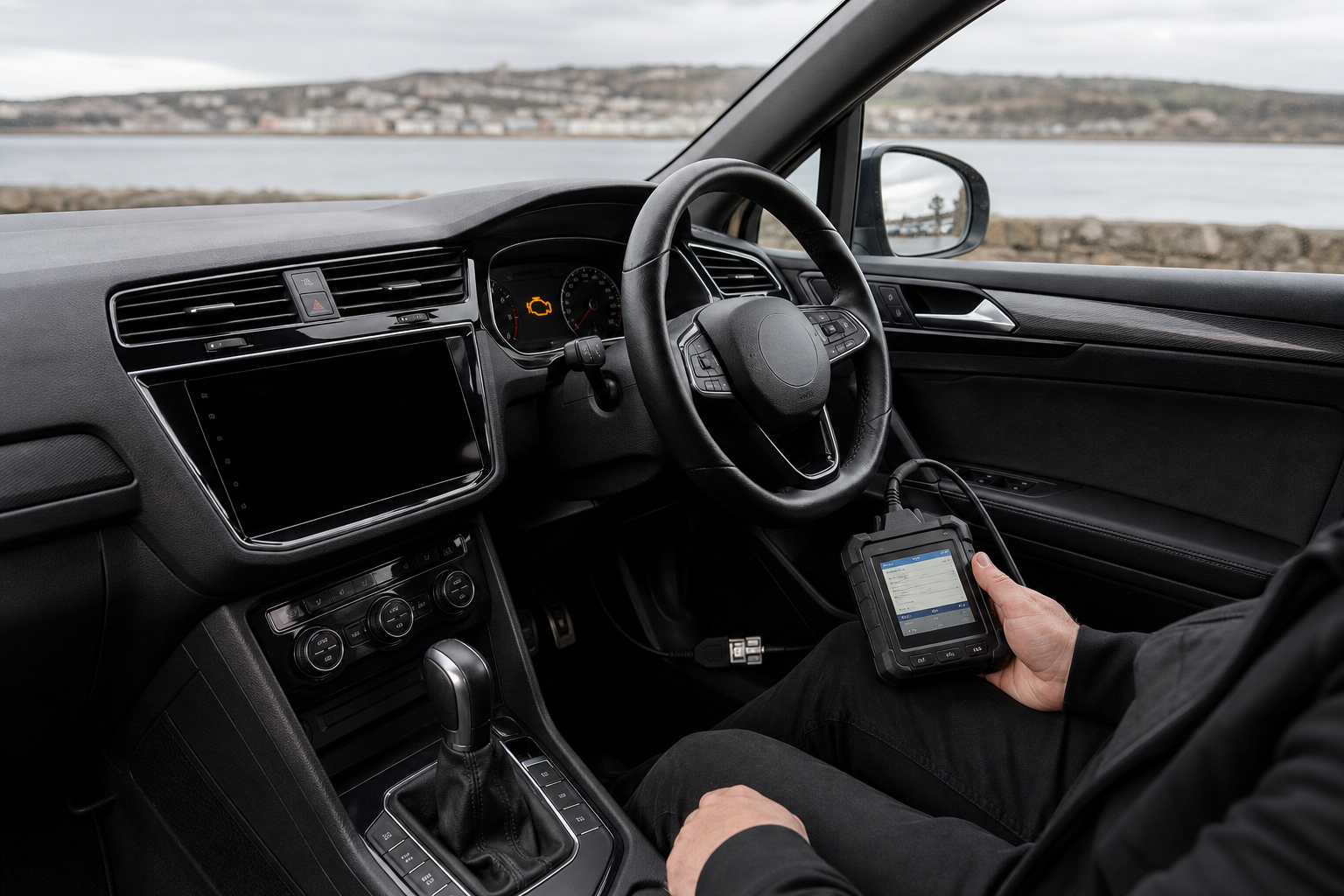
A diagnostic visit is not just a quick code clear. The scope depends on the vehicle, the fault and what can be assessed safely at the location, but it may include reading fault memory, noting whether codes are current or historic, checking freeze-frame information where available and reviewing relevant live data. The technician should also consider the symptoms you have experienced: when the light came on, whether it returns after clearing, whether the vehicle enters limp mode, and whether the issue occurs cold, hot, under load or during regeneration.
Depending on the findings, useful checks can include plausibility of pressure, temperature, airflow, fuel-rail, boost-control or exhaust-sensor readings. A visual assessment may also reveal obvious concerns such as damaged pipework, loose connections, fluid leaks or wiring issues. This is evidence-led investigation, not guesswork and not a substitute for repairs that require specialist workshop equipment or component testing.
Before an appointment, it helps to provide the registration, fuel type, engine size, any dashboard messages and a short timeline of the symptoms. You can use the vehicle lookup page to start checking remap options, but disclose the EML before arranging tuning so that the correct first step can be agreed.
When remapping should be postponed
Postpone ECU tuning where there is evidence of an unresolved fault or where safe, meaningful assessment is not possible. Examples include an active misfire, unstable idle, abnormal smoke, overheating, a low oil-pressure warning, significant fluid leak, serious starting issue, unusual mechanical noise or persistent reduced-power operation.
A steady amber EML still warrants diagnosis before remapping. If the light is flashing, or it is accompanied by severe misfire, overheating, a low oil-pressure warning, smoke or major loss of power, stop safely where appropriate, follow the vehicle manufacturer's handbook and arrange repair or recovery rather than continuing to a remap appointment.
Diesel owners should be especially careful with DPF, EGR and AdBlue/SCR-related warnings. These systems interact with engine operation and emissions control, and a warning can have several causes, from sensor and wiring faults to soot loading, regeneration conditions or dosing-system issues. A lawful diagnostic approach concentrates on identifying the root cause and the appropriate repair or regeneration path. Swansea Remaps offers DPF diagnostic support, as well as EGR and AdBlue/SCR diagnostic support, but does not promote defeat, removal or warning-light suppression for legally required emissions equipment used on public roads. A fully mobile visit can provide assessment and diagnostic support; workshop repair, regeneration or specialist testing may be recommended where necessary.
This is also relevant at MOT time. For applicable petrol vehicles first used on or after 1 July 2003 and applicable diesel vehicles first used on or after 1 July 2008, the DVSA MOT manual requires the engine MIL to illuminate and then go out. Within those applicable vehicle and engine categories, an inoperative lamp or one indicating a malfunction is a major defect. The manual also treats missing, obviously modified or obviously defective manufacturer-fitted emissions-control equipment as a major defect. See the GOV.UK MOT inspection manual.
A diesel particulate filter fitted when the vehicle was built must still be present for the MOT, and removing it results in an MOT failure. Replacement catalytic converters and diesel particulate filters can also be subject to type-approval requirements where the relevant rules apply. See the GOV.UK guidance on catalytic converters and DPFs.
Does clearing the engine management light make the car ready for a remap?
No. Clearing a code removes the current stored fault information from the relevant ECU; it does not repair the cause, and other records or readiness information may remain in scan-tool history, service records or other control units. If the underlying condition remains, the ECU may detect it again after its monitoring conditions have been met. Some faults return immediately, while others reappear only after a cold start, sustained drive, motorway load or a particular operating temperature.
It is therefore better to record the code before it is cleared and investigate why it was set. If a repair has been made, the vehicle should be checked in a way appropriate to the fault before deciding that it is resolved. Do not drive it to test the repair if the symptoms make driving unsafe; follow the vehicle manufacturer’s handbook and seek advice from the appropriate repairer or recovery service. A remap should not be used to hide a warning light, bypass a diagnosis or mask poor running.
How to prepare for a remap after the fault is resolved
- Bring the vehicle with no active warning and no known unresolved running issue; disclose any stored or pending codes, even if the lamp is currently off.
- Tell the technician about previous faults, repairs and intermittent symptoms.
- Ensure the battery is in sound condition and the vehicle has enough fuel for normal checking and road use.
- Be clear about how the car or van is used, including commuting, towing, carrying equipment or regular motorway work.
- Ask whether Stage 1 or Stage 2 is suitable only after the vehicle's condition and supporting hardware have been considered.
For a straightforward overview of the process, see ECU remapping. Swansea Remaps is fully mobile across Swansea and verified surrounding South Wales areas, providing Stage 1 and Stage 2 remapping alongside diagnostic support. There is no dyno service.
The practical answer
Do not book a remap as the first response to an engine management light. Book diagnosis first, repair any active underlying problem, and only proceed with tuning once the vehicle is operating properly and the results can be assessed with confidence. That approach protects the vehicle, produces a clearer outcome and avoids confusing an existing fault with the effects of a calibration change.
If you would like to discuss an EML, fault codes or remapping once a fault is resolved, contact Swansea Remaps with the vehicle details and the symptoms you have seen.
Sources & further reading
External references used to support factual points in this guide.
- www.gov.uk
- www.gov.uk
- www.gov.uk
- www.legislation.gov.uk
- assets.publishing.service.gov.uk
- www.gov.uk
- www.legislation.gov.uk
- www.legislation.gov.uk
- mattersoftesting.blog.gov.uk
- www.gov.uk
- www.legislation.gov.uk
- www.gov.uk
- www.nidirect.gov.uk
- www.legislation.gov.uk
- www.gov.uk
- mattersoftesting.blog.gov.uk
- www.legislation.gov.uk
Results, compatibility and suitable options vary by vehicle, software version, mechanical condition and existing modifications. Always confirm the correct route for your own vehicle before work is carried out.