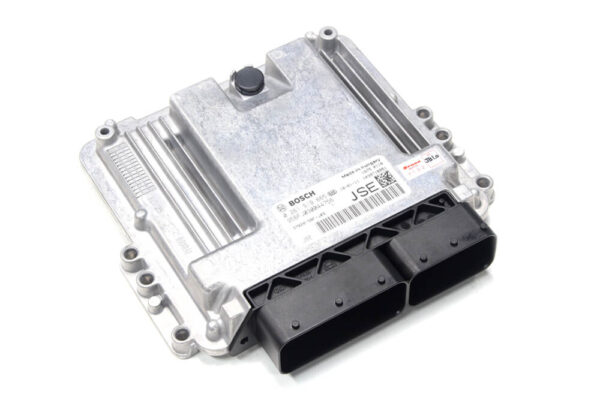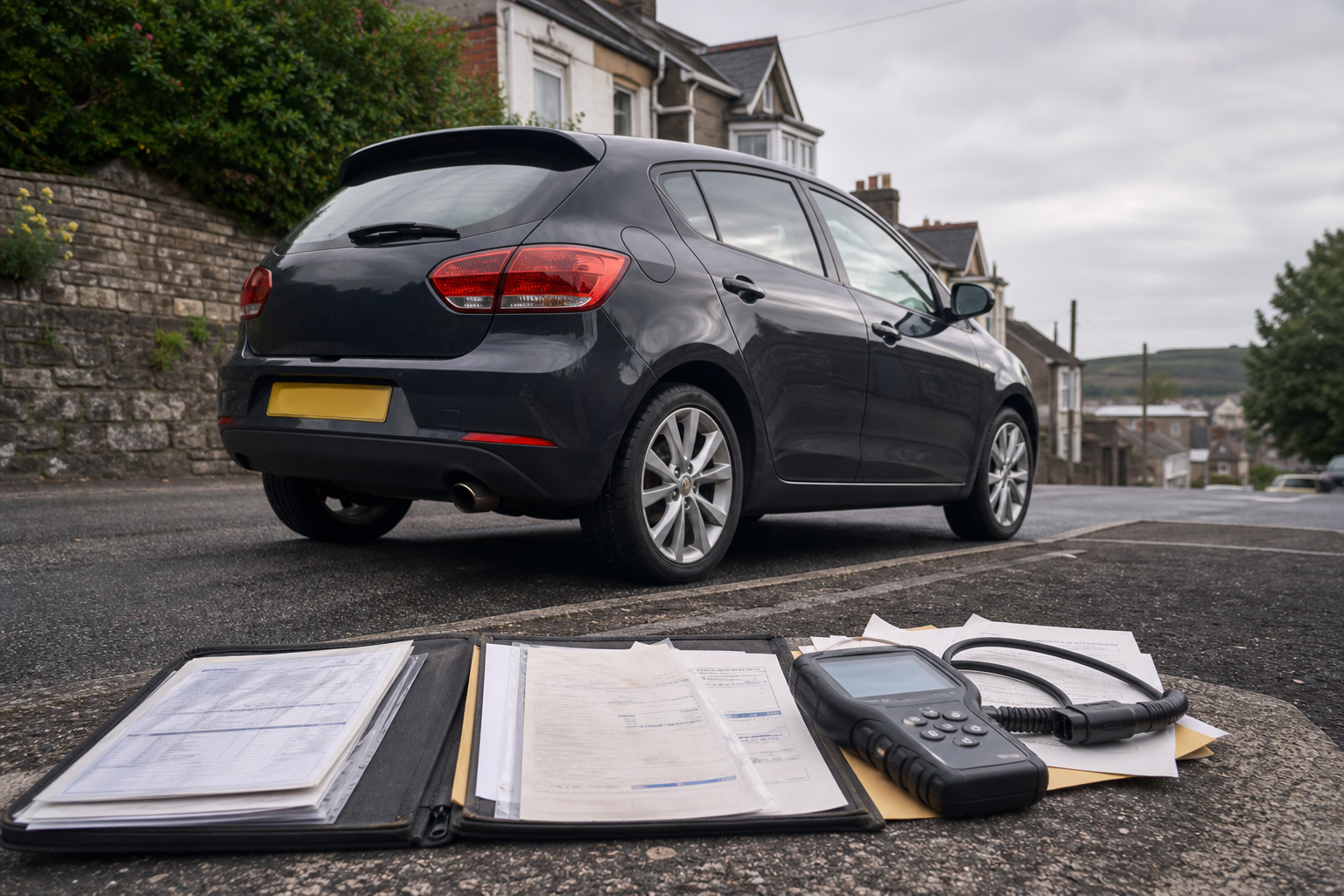
Usually, you should not remap a used car simply because you have just bought it. Start by establishing a credible maintenance and fault baseline. Check its records, review its MOT history, investigate warning lights or symptoms, deal with overdue work and complete a vehicle-specific assessment before discussing Stage 1 or Stage 2 tuning.
There is no evidence-based rule requiring every owner to wait a particular number of days, weeks or miles. A well-documented vehicle with no known concerns may be ready for an earlier conversation than one with missing invoices, unresolved faults or uncertain modifications. The decision should be based on evidence and condition, not the purchase date.
The seven-step used-car remap sequence
- Verify the vehicle and paperwork: compare the supplied details with official records and establish what documentation came with the car or van.
- Review its history: examine service evidence, recorded MOT mileage, previous failures and advisories, recall status and any known modification history.
- Check for warning signs: do not overlook dashboard lights, poor running, unusual smoke or noises, recent limp mode or an unresolved fault.
- Address outstanding maintenance and repairs: follow the manufacturer’s schedule for that exact vehicle and engine rather than relying on a generic interval.
- Use diagnostics appropriately: fault information can guide further investigation, but a code scan cannot certify the whole vehicle as fault-free.
- Check insurance and contractual restrictions: establish your insurer’s requirements and review any relevant warranty, finance or lease terms.
- Discuss tuning only after assessment: Stage 1 or Stage 2 should remain conditional on the individual vehicle being suitable.
If a concern emerges at any stage, pause the remap decision. Tuning should not be used to work around an existing fault or an unknown maintenance position.
Build the paper trail before booking anything
A recently purchased used vehicle often comes with information assembled by several previous owners, garages and MOT stations. Your first task is to identify what the records establish—and what remains unknown.
- Compare the vehicle details supplied to you with the relevant DVLA records.
- Review the service book and supporting invoices rather than relying only on a stamp or the seller’s description.
- Compare invoice dates and mileages with the recorded MOT mileage.
- Look for gaps in the service history and repeated MOT advisories or failures.
- Check the manufacturer’s maintenance schedule for the exact model, engine and transmission.
- Look for evidence of scheduled work where applicable, rather than assuming it has been completed.
- Check for outstanding serious safety recalls.
- Record any declared previous tuning, hardware changes or other modifications.
The GOV.UK used-vehicle checks explain how to verify details, MOT history and recall information. Its MOT history service can show recorded mileage, pass and fail results, failures, minor defects and advisories for eligible vehicles.
These records are useful evidence, but they are not guarantees. A stamp or invoice does not prove that every relevant item was completed correctly, while a history gap does not diagnose a fault. It means the maintenance position needs to be clarified before modification.
A current MOT is not a tuning-readiness certificate
A recent MOT pass is useful, but its meaning is frequently overstated. DVSA explains that an MOT concerns testable items at the time of the test and is not evidence of a vehicle’s general mechanical condition. The test does not cover the condition of the engine, clutch or gearbox.
That distinction matters when considering a remap. An MOT pass cannot answer whether the engine and supporting systems are suitable for altered calibration, nor can it establish how much usable life remains in a clutch, turbocharger or gearbox.
Use the MOT history to identify questions, such as recurring advisories, mileage inconsistencies or previous failures. Do not use the certificate on its own as permission to proceed.
Warning lights and symptoms that should pause the decision
Under Highway Code vehicle-maintenance guidance, dashboard warning lights normally illuminate when the ignition is switched on and should go out after the engine starts, apart from the handbrake warning. A light that remains on or appears while driving warrants investigation. Its meaning and urgency will depend on the vehicle and the warning displayed.
Pause the remap conversation if you are aware of:
- a warning light that remains illuminated or appears while driving;
- poor or inconsistent running;
- unusual smoke or noises;
- recent limp-mode operation;
- a known fault that has not been resolved;
- missing evidence for important scheduled maintenance;
- a concerning or repeated pattern in the MOT history; or
- previous modifications that have not been properly identified.
These signs do not provide a diagnosis by themselves. They are reasons to investigate before changing the ECU calibration. For more detail, see whether a car should be remapped with an engine management light on.
What ECU diagnostics can—and cannot—establish
ECU diagnostics can reveal relevant stored or current fault information and help direct the next stage of assessment. This can be valuable when a used vehicle’s recent history is incomplete or a symptom needs context.
Diagnostics cannot, however, guarantee that the engine, turbocharger, clutch, gearbox, fuel system or emissions equipment is fault-free. They cannot predict component life, and the absence of a warning light or fault code is not a complete mechanical health check.
The sensible approach is to consider diagnostic findings alongside:
- service and maintenance evidence;
- MOT history;
- current warning lights and reported symptoms;
- known previous modifications;
- outstanding scheduled work; and
- how the vehicle will be used.
Swansea Remaps provides fully mobile ECU diagnostics. Where findings indicate that servicing, repair or further mechanical investigation is needed, that work should come before tuning.
Make maintenance and repairs the prerequisite
If servicing is overdue, a fault remains unresolved or important evidence is missing, establish the maintenance and repair baseline first. Do not postpone known work on the assumption that a remap will compensate for poor running or restore a faulty component.
There is no responsible universal list of parts to replace before every remap. Requirements differ between engines, transmissions, mileages and maintenance schedules. Check the manufacturer’s schedule for the exact vehicle and obtain appropriate mechanical advice where records or symptoms call for it.
If you have only just taken ownership, retain the advert, invoices, service records and other supplied paperwork. Keep a dated note of warning lights, symptoms or new concerns. This creates a clearer record than trying to reconstruct events later.
Modern diesel systems: diagnosis is not deletion
DPF, EGR and AdBlue/SCR concerns should be diagnosed rather than treated as equipment to remove or bypass. According to the DVSA MOT inspection manual, relevant manufacturer-fitted emissions-control equipment that is missing, obviously modified or obviously defective can constitute a major defect. Evidence of DPF tampering on a diesel is also covered as a major defect.
A warning or fault involving one of these systems should therefore pause the tuning decision. Diagnostic support means identifying relevant fault information and guiding lawful assessment, repair or regeneration where appropriate. It does not mean removing, coding out, bypassing or defeating legally required emissions controls on a UK public-road vehicle.
Settle insurance and ownership restrictions first
An ECU remap is a vehicle modification for insurance purposes. Check your insurer’s terms and disclose the planned modification as required before proceeding. Do not assume that every insurer will make the same decision or apply the same premium.
The Financial Ombudsman Service’s guidance on vehicle modifications specifically identifies engine tuning and ECU remapping as modifications. It also discusses a case involving an undeclared ECU remap where avoidance of the policy was considered fair.
If the used vehicle has a warranty or is subject to finance or lease conditions, review the relevant terms as well. A remap does not have one automatic outcome across every agreement, so the applicable contract must be checked rather than guessed.
Stage 1 or Stage 2 after buying used?
Stage 1 and Stage 2 are not statutory or universally standardised categories. The appropriate discussion depends on the exact vehicle, its existing hardware and software, its condition, its maintenance evidence and its intended use.
Recent ownership does not automatically rule out Stage 1, but neither does a clean dashboard automatically make the car suitable. The same principle applies more strongly to a Stage 2 enquiry: existing hardware and vehicle-specific requirements need to be identified rather than assumed. The Stage 2 remap hardware checklist explains why that conversation must be specific to the vehicle.
No responsible choice between Stage 1 and Stage 2 can be made from the purchase date, mileage or MOT certificate alone. Suitability remains conditional on assessment.
Three possible outcomes
| Outcome | When it applies | Sensible next step |
|---|---|---|
| Pause and investigate or repair | There are warning lights, symptoms, unresolved faults, concerning history or known overdue work. | Resolve the concern and establish the vehicle’s condition before reconsidering tuning. |
| Monitor and establish a baseline | No immediate concern has been established, but service evidence or previous modification history is incomplete. | Clarify the records, follow the exact manufacturer schedule and assess any uncertainties before deciding. |
| Ready to discuss a remap | The records, present condition, diagnostic findings and insurance position support an individual assessment. | Discuss whether Stage 1 or Stage 2 is appropriate, without treating eligibility or the outcome as guaranteed. |
What to have ready before making an enquiry
- The registration and exact vehicle details.
- Available service records and invoices.
- Relevant MOT advisories and previous failures.
- Details of current or recent warning lights.
- Any poor running, smoke, unusual noises or limp-mode incidents.
- Known previous ECU or hardware modifications.
- How you intend to use the vehicle.
- Your insurer’s position and any relevant warranty, finance or lease restrictions.
You can use the vehicle lookup as an initial enquiry step, but vehicle identification does not replace condition and suitability assessment.
The practical answer
Do not remap a used car solely because you have just bought it—and do not wait an arbitrary period solely because it is used. Verify its history, understand its maintenance position, investigate warning lights or symptoms, use diagnostics within their limits and settle insurance requirements first.
Swansea Remaps provides fully mobile ECU diagnostics and, where a vehicle is suitable following assessment, Stage 1 and Stage 2 ECU remapping across Swansea and surrounding South Wales areas. Swansea Remaps does not provide servicing, repairs, MOT testing, roadworthiness certification or a dyno service.
Sources & further reading
External references used to support factual points in this guide.
- www.gov.uk
- www.nidirect.gov.uk
- www.gov.uk
- www.gov.uk
- www.think.gov.uk
- www.gov.uk
- www.devonsomersettradingstandards.gov.uk
- www.gov.uk
- www.legislation.gov.uk
- www.gov.uk
- www.gov.uk
- www.centralbedfordshire.gov.uk
- www.abi.org.uk
- www.solihull.gov.uk
- www.highland.gov.uk
- assets.publishing.service.gov.uk
- mattersoftesting.blog.gov.uk
- www.think.gov.uk
- How car modifications affect your insurance cover – Financial Ombudsman service
- www.gov.uk
Results, compatibility and suitable options vary by vehicle, software version, mechanical condition and existing modifications. Always confirm the correct route for your own vehicle before work is carried out.