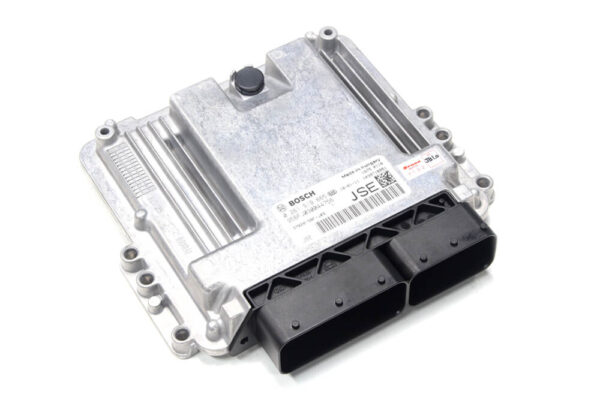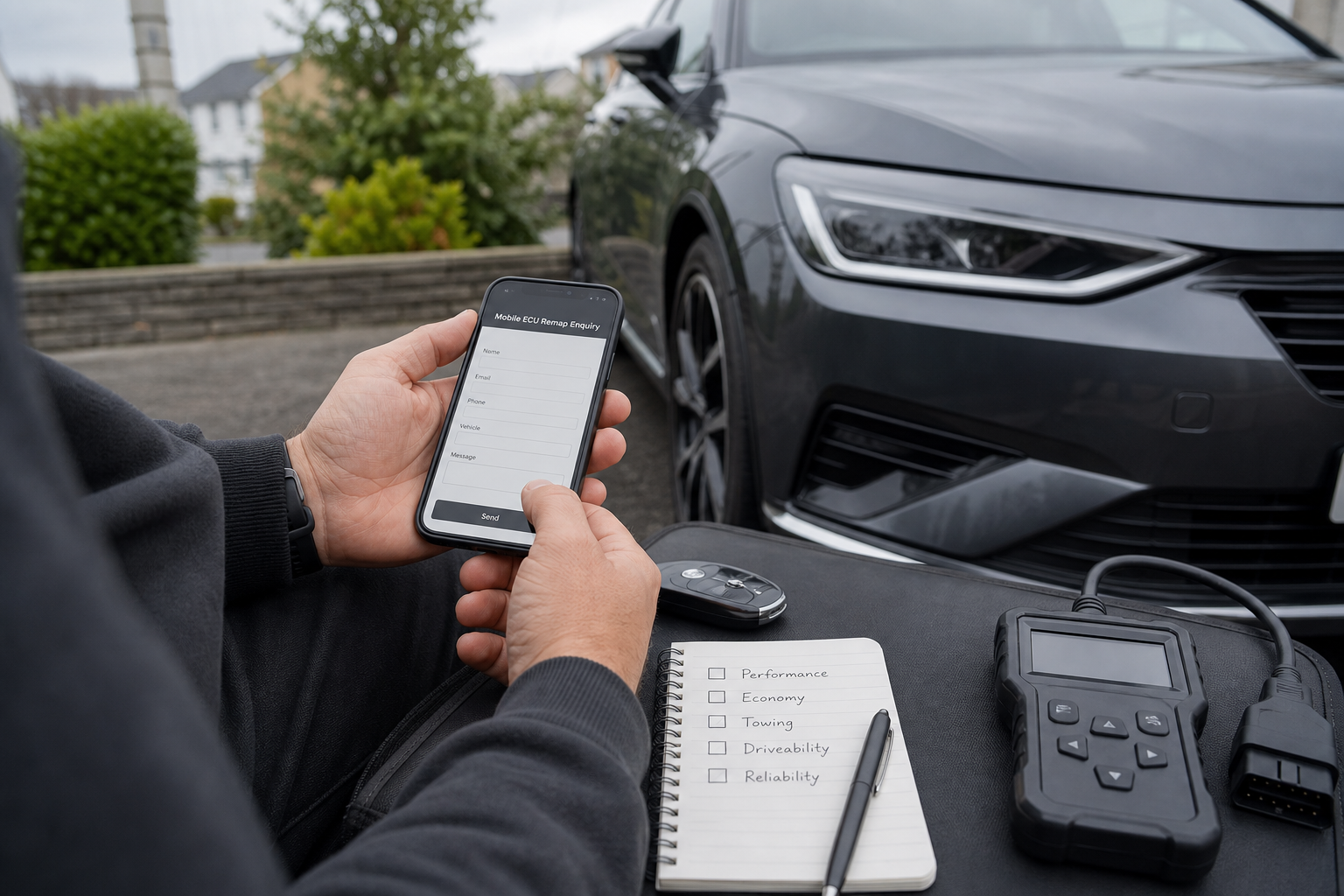
If you are asking what information do I need before booking a mobile ECU remap, send the vehicle registration, exact model and engine details, gearbox type, current mileage, known modifications, previous tuning work, warning lights or fault codes, intended use and appointment postcode. You should also explain where the vehicle can be parked and when you are available.
This information supports an initial suitability conversation. It does not confirm remotely that the vehicle can be remapped or that a Stage 1 or Stage 2 option is appropriate.
Quick answer: what to send before booking
- Registration number
- Make, model and year
- Fuel and engine: petrol, diesel or another fuel type, plus the engine designation or factory output if known
- Gearbox: manual or automatic, including the gearbox type if known
- Current mileage
- Existing modifications: include hardware and software changes
- Previous tuning: any ECU or transmission control unit work
- Vehicle condition: warning lights, reduced-power mode, smoke, unusual behaviour or known faults
- Diagnostic information: unedited fault-code text or scan screenshots if available
- Recent context: relevant servicing, repairs and MOT advisories
- Intended use: commuting, leisure, towing, load-carrying or business use
- Your priority: for example, drivability, economy or performance
- Mobile appointment details: postcode, parking or access constraints and preferred dates or times
Copy-and-send mobile ECU remap enquiry template
You can copy the template below into a message. If you do not know an answer, write “not known” rather than guessing.
Registration:
Make, model and year:
Fuel type:
Engine designation or factory output, if known:
Gearbox type:
Current mileage:

Existing modifications:
Previous ECU or gearbox software work:
Recent relevant repairs or servicing:
Recent MOT advisories, if relevant:

Warning lights currently displayed:
Fault codes or scan information:
Does the vehicle enter reduced-power or limp mode?:
Other symptoms, smoke or unusual behaviour:

Main vehicle use:
My priority for the enquiry:
Stage 1 or Stage 2 requested, if any:

Appointment postcode:
Where the vehicle would be parked:
Parking or access constraints:
Preferred dates or times:
This is a suggested preparation checklist rather than a guarantee that every enquiry can proceed to a booking.
Details to send in every first enquiry
Registration and exact vehicle details
A registration number is a sensible starting point. The DVLA vehicle-information service can use it to return registered details such as engine size, fuel type, registration date, weight, MOT expiry and recorded emissions information.
A plate lookup does not necessarily establish the exact engine variant, gearbox specification, ECU software state or aftermarket parts currently fitted. Registration data can also contain inconsistencies. Add the precise model, year, fuel, engine designation or factory output where known, and whether the vehicle is manual or automatic. Swansea Remaps’ Vehicle Lookup can be used as a starting point, but it should not replace an accurate description of the vehicle.
Mileage and relevant history
Include the current mileage. It gives useful context, but mileage alone cannot prove that a vehicle is either suitable or unsuitable for tuning.
Recent MOT advisories, servicing and repairs may also be relevant. The official MOT history service records test outcomes and mileage and, where available, failures, minor defects and advisories. An MOT record is background information rather than a mechanical health assessment.
Intended use and your actual priority
Explain how the vehicle is used. A daily commuter, privately used car, towing vehicle and loaded work van can present different priorities. State whether you are investigating drivability, economy or performance rather than sending an undifferentiated request for “more power”.
Your goal helps shape the discussion, but it cannot guarantee an output, fuel-saving result, reliability outcome or particular calibration.
Information to add when it applies
Some details are only needed when relevant or requested. These may include:
- VIN or V5C vehicle details
- ECU identification information
- Clear photographs of fitted components
- A diagnostic scan report or screenshot
- Details of recent engine, turbo, clutch, gearbox or fuelling repairs
- Relevant service records or MOT advisories
- Invoices or specifications for aftermarket parts, where available
Do not send sensitive documents unnecessarily. If follow-up identification is required, confirm which specific information is needed.
Warning lights, reduced power and fault codes
Disclose faults before booking: list every illuminated warning lamp, say when it appears, explain whether the vehicle enters reduced-power or limp mode, and attach the unedited diagnostic-code text or scan screenshot if you have it.
Pay particular attention to engine-management, emissions-system, drivetrain and transmission warnings. Do not clear codes merely to make a booking enquiry, and do not assume that remapping will cure the underlying problem.
A diagnostic trouble code identifies an area in which the control system has detected a problem; a message or screenshot is not a complete diagnosis. The information may instead show that ECU diagnostics should be the first conversation. For more context, read Can You Remap a Car With an Engine Management Light On?
A useful fault description
- Which warning lamps are illuminated?
- Are they constantly on or intermittent?
- Do they appear from start-up or only under load?
- Does the vehicle lose power or enter limp mode?
- Are there starting, smoke, hesitation or gear-selection symptoms?
- What are the complete fault codes and descriptions?
- What diagnosis or repair has already been attempted?
Avoid diagnosing the cause yourself unless it has been properly established. Reporting what the vehicle does is more useful than guessing which component has failed.
Existing modifications and emissions equipment
For a meaningful Stage 1 or Stage 2 enquiry, disclose what is actually fitted. Useful categories include:
- Intake or air-filter changes
- Intercooler, pipework or other charge-air components
- Exhaust-system changes
- Turbocharger or supercharger changes
- Injectors, pumps or other fuelling components
- Clutch or driveline changes
- Gearbox software
- Previous ECU remaps, tuning boxes or other ECU work
Give part names or specifications if known, but do not describe the vehicle as modified simply because a previous owner said that it was. If its history is uncertain, say so.
Report emissions-system condition separately
State the known condition of the DPF, EGR system, catalytic converter and SCR/AdBlue equipment where applicable. Include any warning lamps, countdown messages, regeneration problems, smoke or relevant repair history.
For road-going vehicles, emissions equipment should not be treated as something to remove or disable in preparation for a remap. The DVSA MOT inspection manual classifies manufacturer-fitted emissions-control equipment that is missing, obviously modified or obviously defective as a major defect. It specifically addresses equipment including DPF, EGR and SCR systems.
Road-going vehicles must continue to meet the applicable exhaust-emissions requirements after modification. Active DPF, EGR or AdBlue/SCR problems call for diagnosis and lawful repair or regeneration where appropriate—not assumptions that software changes will fix them.
Is this a Stage 1 or Stage 2 enquiry?
Stage 1 and Stage 2 are industry labels rather than universally standardised UK technical categories. Their meaning, hardware expectations and suitability can vary between providers and vehicles. A generic online parts list therefore cannot confirm which label applies.
The better question is:
Given this exact vehicle, its condition, fitted hardware, previous software work and intended use, is a Stage 1 or Stage 2 enquiry appropriate?
A stage label by itself does not establish the required parts, likely output, road legality or mechanical suitability. Swansea Remaps provides Stage 1 and Stage 2 ECU remapping, with each enquiry requiring the relevant vehicle information and assessment. See the ECU Remapping page for the main service information.
Information needed for a mobile appointment
Swansea Remaps is a fully mobile service operating across Swansea and surrounding named areas including Neath, Port Talbot, Llanelli, Gorseinon, Morriston, Mumbles, Pontarddulais and Ammanford.
To help establish whether a mobile appointment can be arranged, provide:
- The appointment postcode
- Where the vehicle would be parked
- Any known parking or access restrictions
- Your preferred dates or appointment windows
- A contact method for follow-up questions
Providing these details does not guarantee availability or that work can be completed at every address. It simply allows the practical arrangements to be considered before a visit is discussed.
Before you commit
- Speak to your insurer. Check your own insurer’s position before proceeding and disclose the remap as required. Insurers may make different decisions about acceptance, terms and premiums. See Will Remapping Affect Insurance in the UK? for further context.
- Investigate active faults. Do not conceal warning lights or assume that software will resolve a mechanical, electrical or emissions-system problem.
- Keep emissions systems lawful. Applicable emissions-control equipment on a public-road vehicle should remain present and functioning, and the vehicle must continue to meet relevant requirements. Read Does ECU Remapping Affect an MOT in the UK? for related MOT considerations.
- Do not rely on an MOT pass alone. An MOT result is not proof of overall mechanical fitness, remap suitability or the legality of every modification.
- Check agreements and cover. If applicable, review your finance, lease, manufacturer or warranty terms. Do not assume every provider treats remapping identically.
The most useful first message is accurate, not long
A clear enquiry does not need to contain every technical identifier. Start with the registration, exact vehicle and gearbox details, mileage, intended use, postcode and goal. Then disclose all known modifications, previous tuning, warnings and faults.
If something is unknown, say so. Accurate uncertainty is more useful than a guessed engine code, an assumed modification list or an unsupported claim that a vehicle is already “Stage 2”. The information can then support an informed discussion about diagnostics, suitability and whether a Stage 1 or Stage 2 enquiry should go any further.
Sources & further reading
External references used to support factual points in this guide.
- www.gov.uk
- www.gov.uk
- www.gov.uk
- www.gov.uk
- www.gov.uk
- www.gov.uk
- www.gov.uk
- www.gov.uk
- www.gov.uk
- www.gov.uk
- www.gov.uk
- www.gov.uk
- assets.publishing.service.gov.uk
- assets.publishing.service.gov.uk
- assets.publishing.service.gov.uk
- assets.publishing.service.gov.uk
- www.bury.gov.uk
- assets.publishing.service.gov.uk
- www.gov.uk
- assets.applytosupply.digitalmarketplace.service.gov.uk
Results, compatibility and suitable options vary by vehicle, software version, mechanical condition and existing modifications. Always confirm the correct route for your own vehicle before work is carried out.