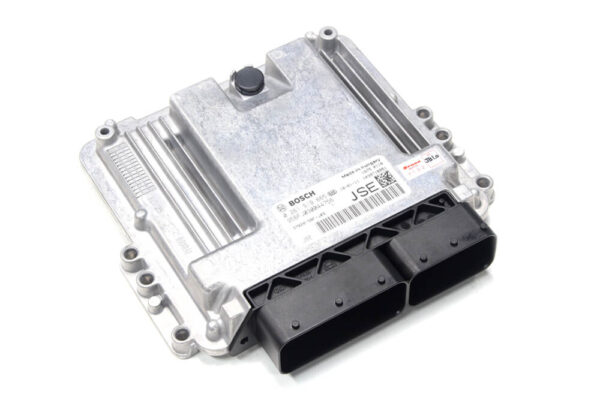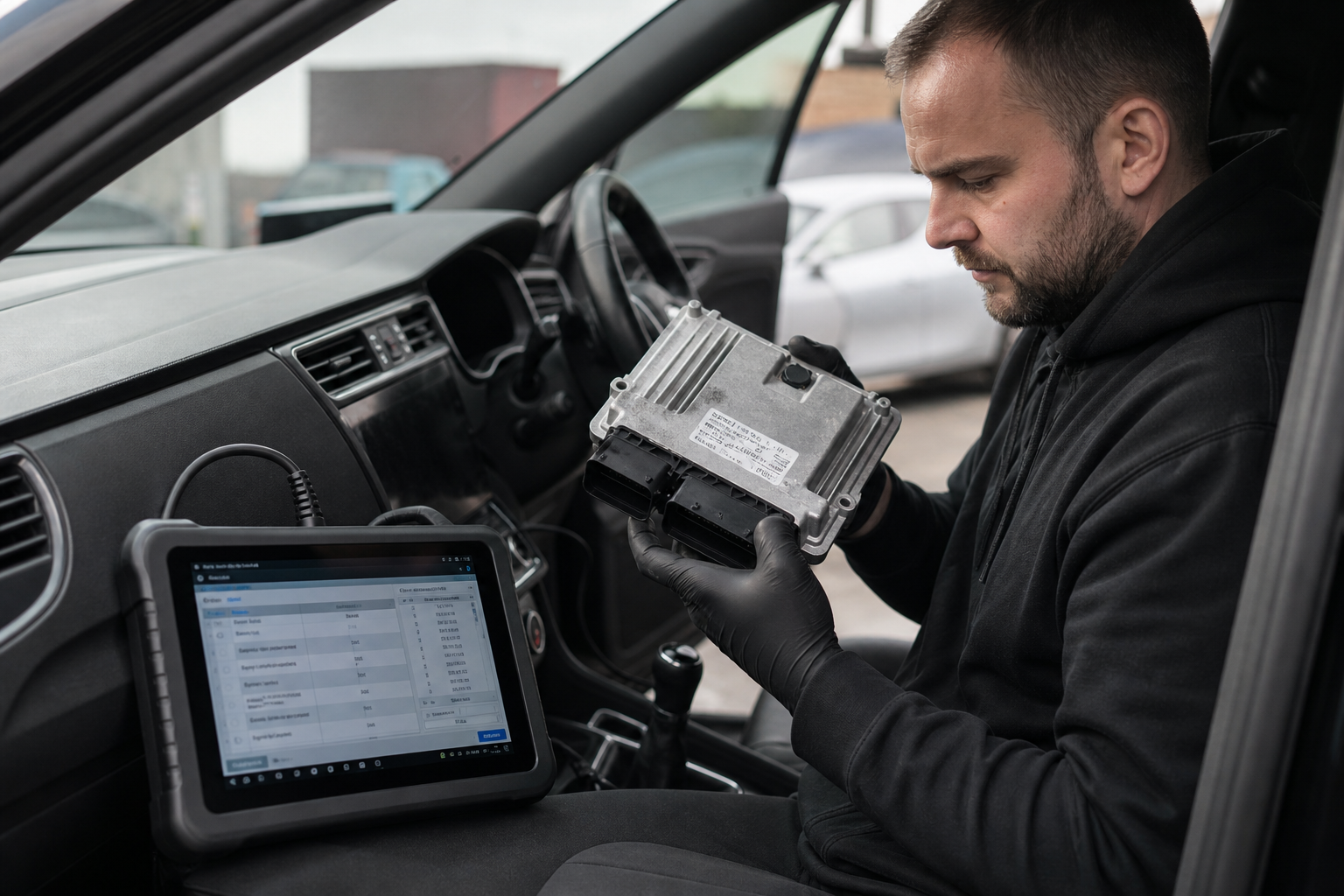
Sometimes—but a replacement ECU should not be remapped automatically. It first needs to be confirmed as compatible with the vehicle, programmed and configured correctly where required, and paired with the immobiliser or security system where applicable. The vehicle should then start, run and communicate normally, with relevant faults resolved, before a Stage 1 or Stage 2 calibration is considered.
A unit that plugs into the wiring loom is not necessarily ready to use. Matching connectors, a similar casing or even the same headline part number may not confirm that its hardware, software, calibration and vehicle configuration are suitable.
The three ECU jobs that are often confused
Replacement ECU programming, security adaptation and performance remapping are separate operations. A vehicle may require one or both of the first two before anybody can make a sensible decision about the third.
| Operation | Purpose | Typical outcome | What it does not prove |
|---|---|---|---|
| Replacement ECU programming and configuration | Loads or confirms suitable manufacturer software and applies the required vehicle configuration. | The replacement module is configured for the relevant vehicle and can communicate as intended. | It does not prove that the vehicle is fault-free or suitable for a performance calibration. |
| Immobiliser or security adaptation | Authorises the replacement ECU within the vehicle’s anti-theft architecture where required. | The ECU and security system recognise each other through the supported vehicle-specific process. | It does not repair an underlying engine, wiring or network fault. |
| Performance remapping | Changes the calibration of an already functioning and supported ECU. | A suitable vehicle receives a Stage 1 or Stage 2 calibration. | It does not replace module programming, security pairing, diagnosis or mechanical repair. |
Manufacturer procedures illustrate why the distinction matters. Some replacement processes include checking the VIN, flashing and configuring the module, completing a security routine and clearing diagnostic trouble codes. Requirements vary considerably between makes, models and security architectures, so one manufacturer’s process cannot be treated as a universal recipe.
The five gates before remapping a replacement ECU
- Establish why the original ECU was replaced.
- Identify both ECUs and the vehicle accurately.
- Confirm the required programming, configuration and security path.
- Verify that the replacement works correctly and that relevant faults are resolved.
- Assess whether a Stage 1 or Stage 2 calibration is supported and appropriate.
If the vehicle cannot pass one gate, the next step is usually further diagnosis or vehicle-specific replacement-module support—not a remap.
Gate 1: diagnose why the original ECU was replaced
An engine management light, a non-starting engine or a stored fault code does not prove that the ECU itself has failed. Power and earth supply problems, wiring damage, CAN communication faults, sensors, actuators and mechanical issues can produce symptoms that appear to implicate the ECU.
Potential causes of actual module damage, such as water ingress or an abnormal voltage event, also need investigation rather than assumption. Otherwise, the condition that affected the original ECU could remain present when its replacement is installed.
A full diagnostic scan should be reviewed in context. That means distinguishing active faults from stored or historic entries, checking which modules communicate and relating the results to the original complaint. Clearing codes or getting the engine to start does not, by itself, establish that the underlying fault has been repaired.
This diagnosis-first approach is especially important if the replacement is being considered for tuning. A remap is not a repair for a warning light, limp mode, a no-start condition or an unresolved emissions-system fault. Read more about ECU diagnostics and why an engine management light should be investigated before remapping.
Gate 2: identify the ECU properly
“It came from the same model” is not enough information. The assessment may need to consider the engine, transmission, emissions configuration, ECU hardware, software reference and calibration identity.
Before buying a replacement, capture:
- the vehicle registration and VIN;
- make, model and model year;
- engine type and, where known, engine code;
- manual or automatic gearbox details;
- clear photographs of the complete original ECU label;
- clear photographs of the complete replacement ECU label;
- hardware and software references;
- calibration identification where diagnostic equipment can retrieve it;
- the source or invoice for the replacement unit;
- details of previous programming, replacement or tuning work, if known.
An apparently identical visible part number is useful evidence, but it is not an infallible compatibility rule. Manufacturers can introduce official supersessions, while the same broader ECU family may appear across vehicles with different software or configurations. Conversely, matching plugs or casing shape do not show that two modules are electronically interchangeable.
The correct conclusion depends on the particular vehicle and full ECU identity. Without that information, nobody can responsibly confirm compatibility or calibration support.
Gate 3: establish the programming and immobiliser requirements
A replacement engine ECU may need manufacturer software, VIN-related configuration or other vehicle-specific setup. It may also have to be authorised within the immobiliser system. Some manufacturer processes use authenticated diagnostic functions and can include parameter resets or key-learning stages.
This is one reason a vehicle may crank but not start after an ECU swap. However, crank-without-start is only consistent with a configuration or security problem; it does not prove one. Fuel delivery, electrical supplies, sensor inputs, wiring, network communication and mechanical condition may also require investigation.
Used ECUs should never be assumed to be plug-and-play. A new ECU is not automatically ready either: depending on the vehicle, it may arrive blank or require configuration and security work before normal operation.
These processes should follow the supported route for the vehicle. Immobiliser deletion, bypassing security controls or manipulating identity data is not an appropriate substitute for correct diagnosis and authorised adaptation.
Gate 4: prove that the vehicle is healthy enough to assess
Before considering calibration, the replacement ECU should operate as a normal part of the vehicle. Practical stop/go checks include:
- stable communication with the engine ECU;
- normal starting and running behaviour;
- reviewed diagnostic results across relevant vehicle systems;
- no relevant unresolved active faults;
- confirmation that the original complaint has been addressed;
- no unexplained warning lamps, limp mode or abnormal behaviour;
- a satisfactory assessment of the vehicle’s general suitability for the proposed calibration.
A single diagnostic trouble code should not be used to condemn an ECU, while the absence of a dashboard warning does not guarantee that every system is healthy. Intermittent problems can leave useful stored information even when the symptom is not present; see the guide to diagnosing intermittent vehicle faults.
Gate 5: decide whether Stage 1 or Stage 2 is appropriate
Once the replacement ECU belongs to the vehicle, communicates properly and the vehicle is operating without relevant unresolved problems, remapping becomes a separate suitability decision.
Calibration availability can depend on the exact ECU hardware and software, not merely the badge on the vehicle. The vehicle’s condition and configuration also matter. Stage 2 requires its own vehicle-specific suitability assessment; it should not be assumed appropriate merely because the ECU is writable.
In short, “the ECU can be accessed” and “the vehicle should be remapped” are not the same conclusion. Information about the available tuning service is provided on the ECU remapping page.
Will the old remap transfer to the replacement ECU?
Do not assume it will. Replacing the ECU does not automatically move the old performance calibration, VIN-related configuration, immobiliser information, adaptations or other vehicle-specific data.
What can be retrieved or reproduced depends on the condition of the original ECU, the identity of the replacement, the vehicle’s security architecture and the supported programming process. A failed or non-communicating original ECU cannot universally be promised recoverable.
Keep the old ECU until the correct replacement path has been established. Retain its label photographs and any invoices or records relating to previous tuning. Even if the old file is available, it should not simply be presumed suitable for a replacement ECU with a different hardware or software identity.
Can MOT history help?
The official GOV.UK MOT history service can show recorded mileage, test results, failures and minor defects. Repeated engine-management or emissions-related entries may provide useful context and justify closer investigation.
However, MOT history cannot prove that an ECU is faulty, establish a donor unit’s provenance or replace a current diagnostic scan. An MOT pass also does not validate a replacement ECU’s programming or confirm that a tuned calibration is suitable.
UK roadworthiness and emissions systems
For cars and light vans where the relevant checks apply, the DVSA MOT inspection manual classifies an inoperative engine malfunction indicator lamp, or one indicating a malfunction, as a major defect. Manufacturer-fitted emissions-control equipment that is missing, obviously modified or obviously defective is also classified as a major defect.
A replacement ECU should not be remapped to conceal a warning, work around an unresolved fault or accommodate the removal or defeat of legally required road-vehicle emissions equipment. DPF, EGR, SCR/AdBlue, catalyst and related sensor faults require proper diagnosis and lawful repair or regeneration where appropriate.
What to send before asking about a remap
- Registration and VIN.
- Make, model and year.
- Engine and gearbox details.
- Full, readable photographs of the replacement ECU label.
- Original ECU details and photographs, if available.
- A diagnostic scan report showing active and stored status where available.
- An explanation of the original fault and why the ECU was changed.
- The replacement ECU’s source or invoice.
- Confirmation of whether the vehicle starts, runs and communicates normally.
- Details of any known previous remap or manufacturer software update.
This evidence will not guarantee compatibility, but it makes an informed assessment far more realistic and can identify when separate programming or security support is required first.
Frequently asked questions
Can a used replacement ECU be remapped?
Potentially, but only after its compatibility, programming, security status and operation in the vehicle have been confirmed. “Used” does not mean plug-and-play.
Can a new replacement ECU be remapped?
Potentially, once any required manufacturer programming, configuration and security adaptation have been completed and the vehicle is operating correctly. New does not necessarily mean pre-configured.
Must the replacement have exactly the same part number?
Not as a universal rule. Full hardware, software and calibration identities matter, and an official superseding part may sometimes be relevant. Equally, matching connectors or a broad ECU-family number do not prove compatibility.
Why does the engine crank but not start after replacement?
Security pairing or configuration may be one possibility, but the symptom is not diagnostic proof. Electrical, communication, fuel, sensor and mechanical causes may produce a similar result.
Should a replacement ECU be remapped to clear a fault?
No. Relevant faults and their causes should be diagnosed and resolved first. Performance calibration is not a substitute for repair or correct replacement-module programming.
When should the remap discussion stop?
Stop if the ECU identity is uncertain, the vehicle does not start or run normally, communication is unstable, relevant active faults remain, or required programming and security work has not been completed. The appropriate next step is vehicle-specific diagnosis or supported programming—not tuning.
Replacement ECU assessment in Swansea and South Wales
Swansea Remaps provides a fully mobile service for ECU diagnostics and supported Stage 1 and Stage 2 remapping across Swansea and surrounding South Wales areas. A replacement ECU should be operating correctly before performance calibration is discussed.
Replacement-module supply, ECU cloning, OEM online programming, key coding and immobiliser adaptation are separate vehicle-specific requirements and are not part of the verified Swansea Remaps service offer. Where those steps are necessary, they need to be completed through an appropriate supported route first.
Sources & further reading
External references used to support factual points in this guide.
- 8. Nuisance
- www.gov.uk
- www.gov.uk
- assets.publishing.service.gov.uk
- www.gov.uk
- www.hella.com
- www.fordservicecontent.com
- www.hella.com
- www.fordservicecontent.com
- www.hella.com
- www.hella.com
- mattersoftesting.blog.gov.uk
- www.hella.com
- www.niassembly.gov.uk
- www.fordservicecontent.com
- www.hella.com
- www.gov.uk
- assets.publishing.service.gov.uk
- static.nhtsa.gov
- static.nhtsa.gov
Results, compatibility and suitable options vary by vehicle, software version, mechanical condition and existing modifications. Always confirm the correct route for your own vehicle before work is carried out.