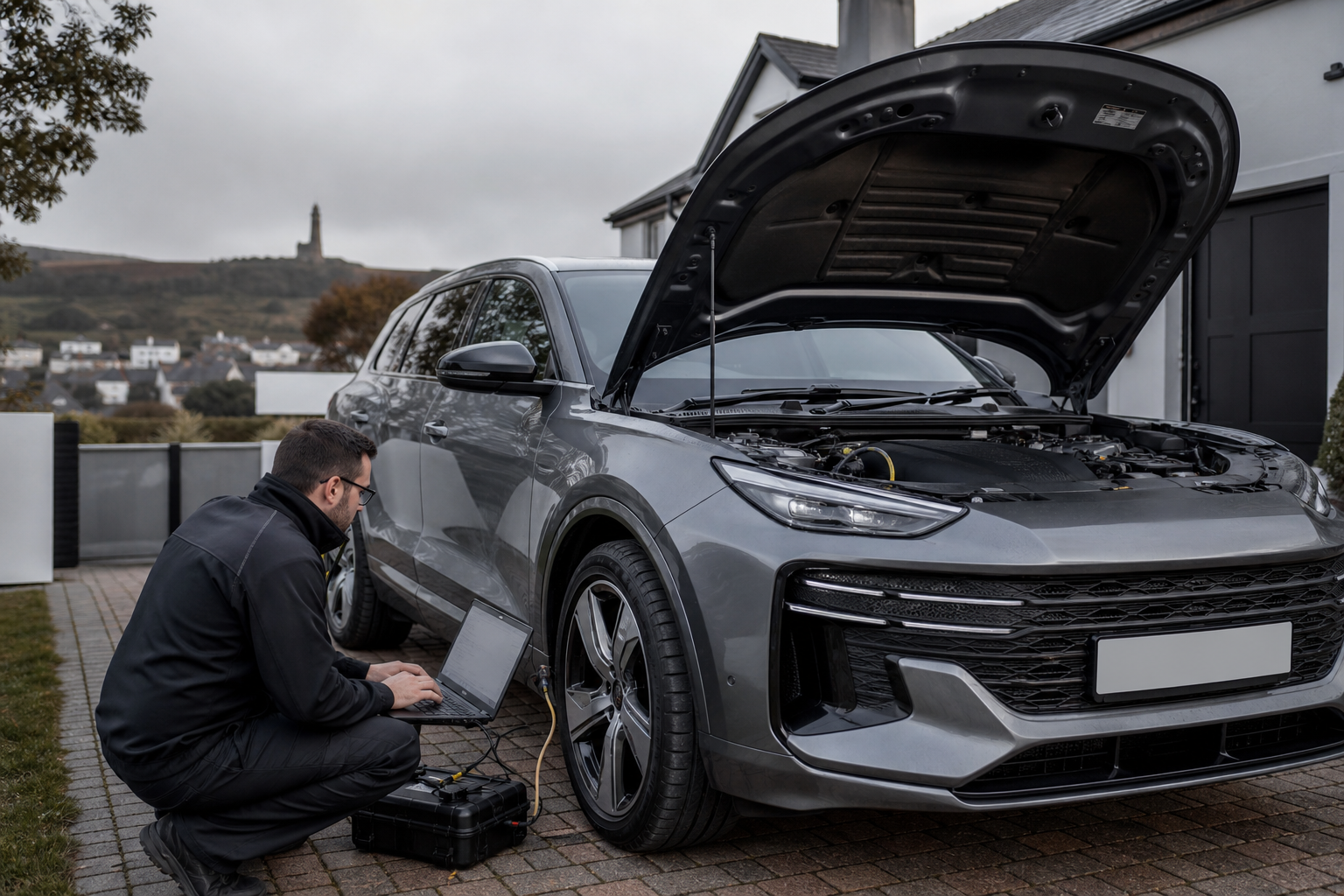
Yes, a Stage 2 remap can potentially be carried out without a dyno, including by a mobile tuner, provided the exact vehicle, ECU and fitted supporting hardware are confirmed as suitable. However, no-dyno tuning cannot provide dyno-measured before-and-after power or torque figures.
It is also important to separate four different questions: whether the ECU can be programmed, whether the vehicle and hardware are suitable, what performance can be measured, and whether the finished vehicle meets its road-use obligations. A diagnostic scan or dyno result cannot answer all four.
Swansea Remaps provides fully mobile Stage 1 and Stage 2 ECU remapping and diagnostics. It does not provide a dyno service, so it does not represent its results as dyno-verified output figures.
What “Stage 2” does—and does not—tell you
Stage 2 is an industry label rather than a regulated, universally standardised specification. Its meaning can vary between engine platforms and tuning providers, as outlined in this stage-tuning overview.
That means a parts list found online for another vehicle is not automatically applicable to yours. Stage 2 does not universally require a particular intake, intercooler, downpipe, catalyst, clutch or fuel-system component. Nor does the label guarantee a particular output or level of reliability.
The useful question is therefore not simply “Is this car Stage 2 ready?” It is:
What does the proposed calibration assume about this exact engine, ECU, fuel, transmission and installed hardware?
Those assumptions should be established before selecting a calibration. Our separate Stage 2 hardware checklist explains how to approach the vehicle’s actual configuration without relying on a universal shopping list.
The four questions that must be kept separate
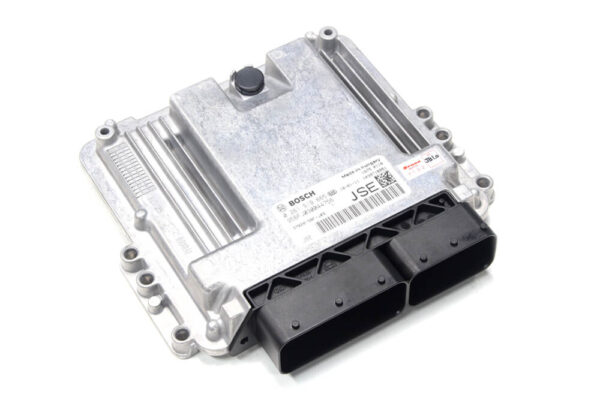
1. Can the ECU be accessed and programmed?
Programming support is specific to the vehicle, ECU and available communication protocol. Technical documentation from Alientech, for example, distinguishes supported operations according to the vehicle, ECU and protocol. This is a general technical principle and does not imply that Swansea Remaps uses a particular equipment brand.
A model badge alone is not enough to promise compatibility. Different model years, engine variants and ECU versions may require different access methods—or may not be supported at all. Compatibility therefore needs to be confirmed for the actual vehicle.
2. Is the stated vehicle and hardware combination suitable?
A calibration must be considered against the configuration that is genuinely fitted, not what an owner believes was fitted or what another driver used. Unknown modifications, incomplete hardware information or unresolved faults create uncertainty that a Stage 2 label cannot solve.
This is a suitability decision, not proof of mechanical condition. Without appropriate evidence, a tuner should not infer the condition of the turbocharger, injectors, clutch, gearbox or other components merely from the vehicle’s mileage, badge or absence of warning lights.
3. What can be measured?
A dynamometer can measure and record outputs such as power and torque. Dynojet’s description of automotive dynamometers supports that specific distinction.
Without a dyno, there can be no honest claim of dyno-verified before-and-after figures. Estimated figures, generic database values and figures from a different vehicle are not measurements of the vehicle being remapped.
4. What remains unproven or separately regulated?
Neither an ECU write, a clear fault-code scan nor a short check afterwards can prove long-term reliability. Equally, measured power on a dyno does not establish road-use emissions compliance. Performance measurement, diagnosis and regulatory compliance require different evidence.
What can and cannot be established from each check
| Information or check | Can be established | Cannot be established from that alone |
|---|---|---|
| Vehicle and ECU identification | Whether a supported programming operation may be available for the actual ECU and protocol | Mechanical health, output or long-term reliability |
| Installed-hardware details | The configuration on which a calibration suitability decision should be based | That every component is correctly fitted, undamaged or capable of supporting an unspecified target |
| Diagnostic trouble-code scan | Recorded anomalies reported by the relevant control units | The root cause of every fault, complete mechanical health or a guaranteed future outcome |
| Dynamometer test | Measured power and torque under the equipment, setup and conditions used | Road-use legality, emissions compliance or long-term reliability |
| MOT result | Whether the vehicle met the applicable inspection criteria at the time of its test | General legal approval of every modification |
What to establish before a no-dyno Stage 2 enquiry
A useful pre-enquiry information pack should identify the vehicle accurately and disclose uncertainty rather than hiding it. Prepare:
- registration and exact model year;
- engine variant or engine code, if known;
- ECU details, if they have already been identified;
- fuel type and transmission;
- a complete list of installed modifications, including brand or part details where available;
- details of any existing remap or unknown previous software;
- current warning lights, stored faults or drivability symptoms;
- recent faults or repairs that may be relevant; and
- whether the vehicle is intended for public-road use.
This is information a tuner can use when considering eligibility; it is not a statement that Swansea Remaps follows a fixed inspection sequence. A vehicle lookup can be a useful starting point, but final ECU and configuration compatibility should not be inferred from a headline vehicle result alone.
What a diagnostic scan can tell you
Diagnostic trouble codes can reveal anomalies recorded by the ECU and other control modules. That can identify a reason to investigate further before tuning. It does not automatically identify the underlying mechanical cause.
A clear scan should not be treated as a mechanical-health certificate. Some developing or intermittent problems may not be represented by a current warning light or stored code. A scan also cannot certify compression, injector condition, turbocharger health, clutch capacity, gearbox condition, fuelling headroom or long-term durability.
Where a warning light, fault code or unexplained symptom is present, diagnosis should come before performance calibration. Swansea Remaps offers ECU diagnostics, but the appropriate investigation will depend on the fault and vehicle.
What a dyno adds—and what it still cannot prove
The principal distinction is measurement. A dyno can record power and torque during a controlled test, making it possible to compare results obtained using that equipment and test setup. Readings can still vary with equipment, setup and conditions, so they should not automatically be treated as universally comparable.
A no-dyno Stage 2 service cannot provide that measured evidence. It may still be technically feasible to programme a supported ECU with a calibration selected for a confirmed configuration, but feasibility is not the same as measured proof of output.
A dyno also does not, by itself, prove:
- that the vehicle complies with road-use emissions requirements;
- that every supporting component is in sound condition;
- that the vehicle will remain reliable over the long term; or
- that an insurance policy covers the modifications.
If independently measured before-and-after output is essential to your decision, a no-dyno service is not the right route for that requirement.
Supporting hardware must match the proposed calibration
Because Stage 2 has no universal specification, supporting hardware should not be selected from a generic list. First establish the exact engine platform, ECU, fuel, transmission and components already installed. Then establish what the proposed calibration assumes.
If a calibration depends on particular hardware, that hardware should be identified and appropriately fitted before the calibration is selected. Where its condition or installation is uncertain, an appropriate mechanical workshop or specialist assessment may be needed before remapping.
Realistic calibration limits are also vehicle-specific. A credible decision should not chase an unsupported power figure or copy another owner’s setup. Where the evidence needed to confirm suitability is missing, the responsible next step is to pause—not to fill the gaps with assumptions.
Road-use emissions, MOT and insurance
Do not treat emissions-control removal as a Stage 2 requirement
For vehicles used on UK public roads, Stage 2 should not be presented as requiring the removal, defeat or manipulation of a DPF, GPF, catalytic converter, EGR system or SCR/AdBlue system.
The current DVSA MOT inspection manual classifies visible and identifiable manufacturer-fitted emissions equipment that is missing, obviously modified or obviously defective as a major defect. Evidence of DPF tampering is also treated as a major defect.
An MOT pass does not provide general legal approval for a modification. It records the outcome against the relevant MOT criteria at the time of inspection.
The 2026 Government consultation
As checked on 14 September 2026, the Department for Transport’s in-use emissions consultation proposes strengthened rules. It identifies DPF or GPF removal, catalytic-converter removal, SCR or AdBlue manipulation, and diesel EGR manipulation—including ECU remapping—as modifications the Government would always consider illegal because of their emissions impact.
This must be described accurately as a consultation proposal and statement of the Government’s view, not as confirmation that a new rule created by the consultation has already taken effect. Swansea Remaps does not promote emissions-control defeat for public-road vehicles.
Tell your insurer before proceeding
An ECU remap and other relevant modifications should be disclosed to your motor insurer. The Financial Ombudsman Service advises drivers to inform insurers about modifications and documents how non-disclosure can affect cover and claims.
Insurer decisions vary, so ask before proceeding and consider retaining written confirmation. DVLA notification is a separate question: current guidance requires V5C details to be updated where a change affects recorded information such as engine capacity or fuel type. It does not list a software-only remap as a standalone V5C-change category, although owners should check whether their wider physical conversion changes any recorded details.
When to pause instead of booking Stage 2
Further investigation is the more sensible next step when:
- an engine-management or other relevant warning light is on;
- there are unresolved fault codes or drivability symptoms;
- the ECU or programming protocol has not been confirmed;
- the installed hardware specification is incomplete or uncertain;
- the proposed setup depends on defeating road-use emissions controls;
- you expect guaranteed power, torque, economy or reliability figures;
- you require independently measured before-and-after output; or
- your insurer has not confirmed its position on the modification.
Depending on the uncertainty, the appropriate next step may be fault diagnosis, lawful emissions-system repair or regeneration where suitable, assessment by a mechanical specialist, or testing by an independent dyno facility.
The practical conclusion
A Stage 2 remap without a dyno can be possible, but “possible to programme” is not the same as “proven suitable in every respect”. The vehicle, ECU and installed hardware must first be considered as an exact combination. Without a dyno, there will be no dyno-verified power or torque figures. With or without a dyno, diagnostics, mechanical condition, emissions compliance and insurance remain separate issues.
Swansea Remaps offers mobile Stage 1 and Stage 2 remapping and diagnostics in Swansea and surrounding stated areas including Neath, Port Talbot, Llanelli, Gorseinon, Morriston, Mumbles, Pontarddulais and Ammanford, subject to vehicle compatibility and availability. To discuss an enquiry, provide the vehicle details, modifications and current fault status through the contact page.
Sources & further reading
External references used to support factual points in this guide.
- www.gov.uk
- www.gov.uk
- www.gov.uk
- skillsengland.education.gov.uk
- www.gov.uk
- www.alientech-tools.com
- www.gov.uk
- www.gov.uk
- www.gov.uk
- www.alientech-tools.com
- www.gov.uk
- www.gov.uk
- www.alientech-tools.com
- assets.publishing.service.gov.uk
- assets.publishing.service.gov.uk
- uk-air.defra.gov.uk
- modgov.cherwell.gov.uk
- www.legislation.gov.uk
- www.dynojet.com
- tuningbot.com
Results, compatibility and suitable options vary by vehicle, software version, mechanical condition and existing modifications. Always confirm the correct route for your own vehicle before work is carried out.