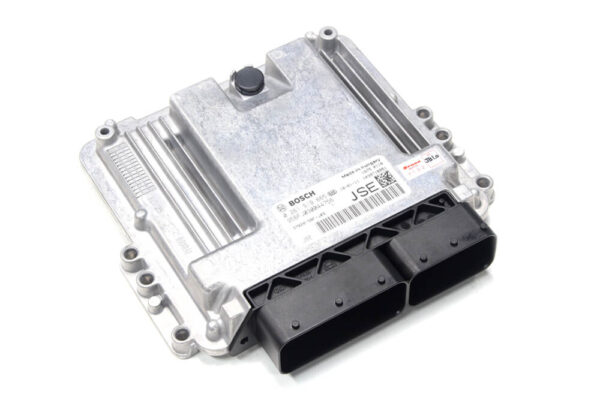
A CAN-PHANTOM immobiliser and a vehicle tracker perform different security roles. CAN-PHANTOM is intended to add a PIN-based barrier to unauthorised engine starting. A tracker is intended to help locate a vehicle and support recovery after it has been stolen. Neither makes theft or recovery outcomes certain.
The right choice depends on the problem you are trying to solve: preventing an unauthorised start, supporting post-theft recovery, meeting a precise insurance condition, or creating separate prevention and recovery layers.
CAN-Phantom vs tracker: the short answer
| Question | CAN-PHANTOM immobiliser | Vehicle tracker |
|---|---|---|
| What is its primary role? | To require a user-selected PIN sequence before the engine can be started. | To provide location information and, depending on the service, support a recovery process. |
| When is it intended to matter? | Before an unauthorised person can start the engine. | After theft or when an unauthorised movement alert is generated, depending on the product. |
| Does it show the vehicle’s location? | No. Location and recovery are not its role. | Potentially, but location access, monitoring and escalation differ between products. |
| Does it restrict engine starting? | That is its intended function. | Not necessarily. Tracking or S5 status must not be taken to mean “no tag, no start”. |
| Does it guarantee protection? | No. | No. A tracker cannot guarantee that a vehicle will be recovered. |
This is therefore not a simple contest in which one device is universally better. An immobiliser is not a recovery system, while a tracker is not automatically a start-prevention device.
What a CAN-PHANTOM immobiliser is designed to do
CAN-PHANTOM is an aftermarket CAN-bus immobiliser. According to the manufacturer’s product information, it uses a personalised PIN sequence entered through supported vehicle buttons or switches. The sequence must be accepted before the engine can start.
Its purpose is narrow but important: to help restrict unauthorised engine starting. It should not be described as making a vehicle impossible to steal or as defeating every possible theft method.
CAN-PHANTOM does not provide:
- live vehicle location;
- post-theft journey history;
- a monitored recovery service;
- a guarantee that a theft attempt will fail;
- automatic compliance with an insurer’s tracker requirement.
Compatibility must also be confirmed for the exact vehicle and year rather than assumed. Owners considering this type of protection can review the CAN-PHANTOM installation service and the practical questions to ask before booking an installation.
What a GPS or stolen-vehicle tracker is designed to do
A tracker’s central role is location and recovery support. If a vehicle is stolen, the system may supply location information to the owner or a monitoring provider. The exact response depends on the device, service package, network availability and reporting procedure.
The term “tracker” covers products with materially different capabilities:
- Self-monitored devices may display location information in an app, leaving the owner to notice and report the theft.
- Professionally monitored systems may include a monitoring centre and a defined theft-reporting or recovery-support process.
- S7 systems sit within Thatcham’s asset-location category.
- S5 systems are vehicle-tracking systems that include Automatic Driver Recognition.
- Packages with additional immobilisation may offer functions beyond tracking, but these must be confirmed in the exact specification.
A Bluetooth tag, connected-car app and monitored stolen-vehicle-recovery system should not be assumed to offer equivalent capabilities. UK tracker guidance also makes clear that tracking cannot guarantee either theft prevention or recovery.
The practical comparison: prevention, recovery and ongoing obligations
| Buying consideration | CAN-PHANTOM | Tracker | Layered approach |
|---|---|---|---|
| Primary concern | Unauthorised engine starting | Location and recovery after theft | Separate measures for both stages |
| Location visibility | Not provided | Depends on the device and service | Provided by the tracker layer only |
| Start restriction | PIN-gated starting is the intended function | Not inherent to tracking or S5 status | Provided by the immobiliser unless the exact tracker package has a verified additional function |
| Monitoring | Not a tracking or recovery service | May be self-monitored or professionally monitored | The tracker’s monitoring terms still apply |
| Ongoing obligations | Confirm installation, operating and insurer requirements | May require activation, subscription renewal and adherence to a reporting process | Requires the owner to maintain each layer correctly |
| Insurance relevance | Must not be assumed to satisfy a tracker condition | Must match the insurer’s named device or category and other policy conditions | Still requires written confirmation from the insurer |
| Main limitation | Does not locate a stolen vehicle | Does not necessarily prevent an engine from being started | More components and responsibilities, without a guarantee |
Layering can be rational when the consequence of losing the vehicle is high and the owner wants distinct measures for start authorisation and recovery. It is not automatically necessary for every owner, and adding layers does not turn vehicle security into a certainty.
S5, S7 and ADR: tracker category does not automatically mean immobilisation
Thatcham Research’s security categories distinguish Category S5 vehicle-tracking systems from Category S7 asset-location systems. S5 includes Automatic Driver Recognition, commonly referred to as ADR.
ADR can identify whether a recognised driver tag is present and may trigger an alert when it is not. That does not automatically mean the system prevents the engine from starting. Remote immobilisation is not a mandatory consequence of S5 status, and any additional immobilisation feature depends on the particular product or package.
If start prevention is your priority, do not buy a product solely because “S5” appears in its description. Ask directly:
- Does this exact system restrict engine starting?
- Is that function part of the certified system or a separate feature?
- What does ADR trigger when the driver tag is absent?
- Is the system self-monitored or professionally monitored?
- Does my insurer require this precise product, category or service level?
Which option fits your parking and vehicle-use pattern?
Your main concern is unauthorised engine starting
If your priority is placing another authorisation step between access to the vehicle and starting its engine, a PIN-based immobiliser is the more directly relevant category. This may be a consideration for cars or vans parked on a driveway, on the street or away from home, but the parking location alone cannot predict theft risk.
For a closer look at this use case, read the practical guide to CAN-PHANTOM and driveway parking.
Recovery and vehicle downtime are your main concerns
A tracker may deserve greater priority where locating a stolen vehicle and supporting recovery are the main objectives. This can matter when losing access to a car or working van would have serious practical consequences.
Before choosing one, establish whether you need simple app-based location, professional monitoring, ADR or a particular insurer-recognised specification. Those are not interchangeable features.
Your insurer requires a tracker
Follow the policy wording rather than choosing a product based on a general label. An insurer may specify a category, named device, fitting evidence, activation deadline or active subscription.
A CAN-PHANTOM installation should not be treated as a substitute for a required tracker unless the insurer explicitly confirms that in writing. Equally, Thatcham certification does not itself guarantee that an insurer will accept a system.
You depend on a work van every day
Consider both the method of theft you want the security measure to address and the operational consequences of loss. Start authorisation and post-theft recovery are separate decisions. Drivers should also consider who needs legitimate access to the van and how its normal operating procedures will work with the chosen system.
Our guide to CAN-PHANTOM for an everyday work van covers practical questions for working vehicles.
You want both prevention and recovery layers
Using an immobiliser and tracker together may make sense when you deliberately want two different functions: one intended to restrict unauthorised starting and another intended to support location and recovery.
Before paying for both, verify that the products do not merely duplicate features you do not need. You must also be willing to maintain any activation, tag, subscription and reporting requirements attached to the tracker service.
Before buying: check the insurer wording and product details
Ask your insurer these questions before installation:
- Is a tracker required? If so, ask for the exact category, named product or specification.
- Is professional installation evidence required? Find out what certificate or record the insurer expects.
- Must the system be activated by a deadline? Installation and activation may be treated as separate steps.
- Must a subscription remain active? Confirm whether theft cover depends on continued monitoring.
- Must the security installation be declared? Do not assume an aftermarket security product is exempt from disclosure.
- What records should be retained? Keep relevant installation, activation and subscription documents.
Ask the product supplier or installer:
- Is the exact vehicle and model year supported?
- What does the product do when used normally?
- Is the tracker self-monitored or professionally monitored?
- Who must be contacted first after a suspected theft?
- What happens if a subscription expires?
- Does the product include start restriction, or only tracking and ADR?
For further insurance preparation, see questions to ask your insurer about CAN-PHANTOM.
If a tracker-equipped vehicle is stolen
Do not treat an app location as an invitation to recover the vehicle yourself. A sensible safety-first sequence is:
- Report the theft to the police and obtain the relevant incident or crime reference.
- Follow the tracker provider’s theft-reporting procedure, where applicable.
- Notify the insurer in accordance with the policy terms.
- Provide requested information to the police, insurer and monitoring provider.
- Do not confront suspects or attempt a self-recovery.
The provider’s process matters because a monitored recovery service may work differently from a location-only device.
Business vans and fleet tracking: privacy is part of the decision
For employers: vehicle-location and telematics information can constitute personal data. The Information Commissioner’s Office says workers and passengers should be informed about vehicle monitoring. It also says monitoring during permitted private use will rarely be justifiable.
Businesses considering trackers should address data-protection obligations, access to location records, retention and private-use arrangements rather than treating tracking solely as a hardware decision. The ICO’s worker-monitoring guidance provides further general information. This is compliance awareness, not individual legal advice.
So, should you choose CAN-PHANTOM, a tracker or both?
- Consider CAN-PHANTOM when your defined priority is adding PIN-based start authorisation.
- Consider a tracker when location and recovery support are the priority or your insurer requires a precise tracker specification.
- Consider both when you deliberately want separate prevention and recovery layers and accept the tracker’s ongoing obligations.
- Choose neither without checking if you have not yet confirmed compatibility, product capabilities or insurance conditions.
Swansea Remaps provides fully mobile CAN-PHANTOM immobiliser installation across Swansea and surrounding South Wales areas. Tracker supply, installation, monitoring and recovery services are not presented as Swansea Remaps services. If PIN-based start authorisation is the role you need, contact Swansea Remaps to discuss your vehicle and confirm compatibility before booking.
Information and cited guidance checked against the supplied evidence on 2 October 2026.
Sources & further reading
External references used to support factual points in this guide.
- www.thatchamtrackers.com
- www.thatchamtrackers.com
- www.ons.gov.uk
- www.thatchamtrackers.com
- www.tracker.co.uk
- www.thatchamtrackers.com
- www.thatchamtrackers.com
- www.thatcham.org
- www.ons.gov.uk
- www.tracker.co.uk
- www.thatchamtrackers.com
- www.tracker.co.uk
- www.gov.uk
- www.thatcham.org
- www.thatcham.org
- www.tracker.co.uk
- assets.publishing.service.gov.uk
- www.tracker.co.uk
- www.reddit.com
- www.reddit.com
Results, compatibility and suitable options vary by vehicle, software version, mechanical condition and existing modifications. Always confirm the correct route for your own vehicle before work is carried out.