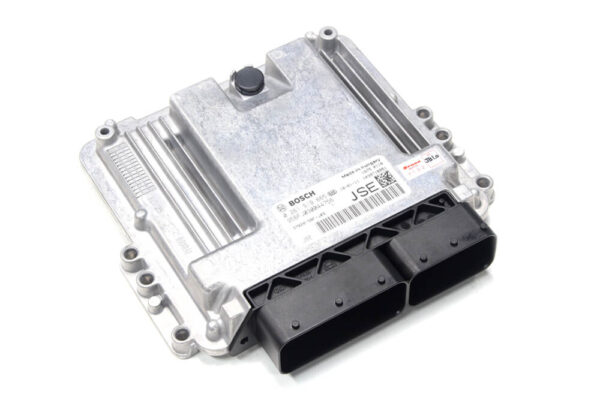
Yes. An ECU remap can affect an automatic gearbox even when the gearbox software is untouched. The main reason is that a remap may change the amount and delivery of engine torque the transmission must handle. On many vehicles, the engine and transmission controllers also exchange torque-related information and coordinate torque management.
That does not mean every remapped automatic will develop a fault, or that every vehicle needs separate gearbox software. Suitability depends on the exact transmission, its calibration and condition, its maintenance history and how the vehicle is used. The word automatic alone does not identify any of those things.
Why an engine remap can change what the gearbox experiences
An engine-only remap does not directly rewrite the gearbox controller. It can still change the gearbox’s working conditions through three connected parts of the drivetrain:
- The engine ECU influences torque delivery. Its calibration affects how the engine responds across different speeds and loads.
- The transmission must carry that torque. Depending on its design, drive may pass through a torque converter and internal clutch elements, through a dual-clutch arrangement, or through another transmission architecture.
- Electronic control may be coordinated. On many vehicles, the engine and transmission controllers exchange torque-related information so that engine output and gear changes can be managed together.
OEM technical material provides real examples of transmission behaviour being linked to engine-torque data and torque-management calibration. However, the communication strategy is not identical across every vehicle. It would be unsafe to assume either that the gearbox will ignore an engine remap or that its factory protection strategies will always contain every unsuitable torque increase.
Torque is more useful than headline horsepower alone
Peak horsepower does not tell you enough about the load placed on a gearbox. The transmission has to carry engine torque, and the way that torque arrives matters as well as the headline maximum.
For example, a sharp increase at low engine speed can create a different demand from smoother delivery spread through the rev range. This does not provide a universal formula for what is safe; it shows why responsible calibration must consider the particular engine, transmission and vehicle rather than chase a single maximum figure.
Intended use also matters. Towing, regular heavy payloads, repeated hard launches and demanding commercial-van work can expose the drivetrain to different conditions from light everyday driving. Those uses are reasons for a more cautious assessment, particularly if the gearbox already has inconsistent shifts or an uncertain maintenance history.
Torque-converter, DSG and CVT gearboxes are not interchangeable
| Transmission family | Basic distinction | Why exact identification matters |
|---|---|---|
| Torque-converter automatic | Typically transfers drive through a torque converter before managing ratios through internal transmission components and clutch elements. | Different models have different hardware, calibrations, fluid requirements and input-torque envelopes. |
| Dual-clutch transmission | Uses two clutches to direct torque into separate gearbox input shafts. DSG is Volkswagen Group terminology; other manufacturers use names such as S tronic or their own descriptions. | Dual-clutch variants do not all use the same clutches, lubrication arrangement or control strategy. |
| CVT | A continuously variable transmission is another distinct transmission family rather than a DSG or conventional stepped automatic. | It must be assessed from its exact design and application, not from blanket claims about all CVTs. |
This is an architecture comparison, not a durability league table. It is not accurate to say that every torque-converter automatic is stronger than every DSG, or that an entire transmission family is automatically suitable or unsuitable for remapping.
A documented design limit is not a transferable “safe torque” figure
Transmission input-torque limits are genuine engineering parameters, but they are specific to the unit and its application. Volkswagen training documentation for one particular older seven-speed dry-clutch transmission, the 0AM/DQ200, describes it as intended for engine applications up to 250 Nm.
That figure must not be used to assess another gearbox. It is not a recommendation for a different DSG, another Volkswagen Group transmission, a torque-converter automatic, a CVT or a van. Even two vehicles from the same manufacturer may have different gearbox codes, drivetrains and calibrations.
This is why online “safe Stage 1 torque” tables should be treated cautiously unless they identify the exact transmission, engine version, model year, drivetrain and supporting manufacturer documentation.
ECU remap versus TCU software
An ECU remap changes the engine calibration. On many vehicles, a separate transmission control unit, or TCU, controls gearbox functions.
Changing the ECU does not automatically mean the TCU must also be altered. Equally, it should not be assumed that standard gearbox software will always limit or reject any additional torque in a way that guarantees protection. The need for transmission-calibration work, if any, is vehicle-specific and cannot be decided from the manufacturer badge or the label “automatic”.
Swansea Remaps provides Stage 1 and Stage 2 ECU remapping only. Its listed services do not include TCU or gearbox remapping, transmission servicing or gearbox repair.
What should be checked before remapping an automatic?
A useful assessment begins with identification and current condition, not a generic claim that the gearbox can “take it”.
- Identify the exact vehicle. Record the registration or VIN, engine version, model year and drivetrain. A Vehicle Lookup can help with initial vehicle information, but it does not certify gearbox suitability.
- Confirm the gearbox code where possible. A broad description such as DSG, eight-speed automatic or CVT may still cover several substantially different units.
- Review documented maintenance. Check the manufacturer’s requirements for the exact transmission rather than relying on a generic service interval or fluid recommendation.
- Discuss how the vehicle is used. Include towing, regular payload, commercial work and repeated hard acceleration rather than assessing the vehicle as if it is always lightly loaded.
- Check for symptoms and leaks. Shuddering, slipping, delayed engagement, harsh shifts or fluid loss require attention before more torque is considered.
- Read relevant fault information. ECU Diagnostics can provide useful fault information, but a clear scan cannot prove the condition of clutch packs, internal wear or hydraulic components.
- Choose the responsible next step. That might be further diagnosis, repair, transmission servicing by an appropriate provider, a more conservative calibration decision or no remap.
For a broader engine and vehicle assessment, see Is My Car Ready for a Stage 1 Remap? A Pre-Booking Health Check.
Should the gearbox be serviced before an ECU remap?
Sometimes, but not as an automatic rule. If servicing is overdue, the history is uncertain or the gearbox has symptoms linked to fluid condition or level, those concerns should be investigated before adding torque.
The correct automatic-transmission fluid, service method and level-setting process depend on the exact gearbox. ZF’s published 8HP service information, for example, specifies the fluid and requires the level to be checked within a defined oil-temperature range while following a set process. That illustrates why an automatic gearbox service is not a generic drain-and-fill job.
Do not assume that every gearbox needs a flush, select fluid from a general description or attempt an adaptation reset as a precaution. Manufacturer information and the requirements for the identified transmission should guide the work. Where servicing or internal assessment is needed, it should be handled by a competent transmission service provider.
Problems to diagnose before considering more torque
Pause the tuning decision if the vehicle has any of the following:
- a transmission warning or relevant stored fault;
- engine speed rising without matching acceleration, sometimes described as flare or slip;
- shuddering or judder under acceleration;
- delayed selection of drive or reverse;
- harsh, erratic or unexpectedly delayed gear changes;
- visible transmission-fluid leaks;
- an unknown service history combined with gearbox symptoms.
Tuning should not be used to disguise an existing drivability problem. Judder can also originate outside the gearbox, so diagnosis should consider the wider vehicle rather than replacing parts by guesswork. See Car Juddering Under Acceleration: What Should Be Diagnosed First?.
Can a diagnostic scan prove the gearbox is healthy?
No. A scan can reveal useful stored faults and live information where supported, but it cannot certify future reliability or prove that every internal component is healthy. A gearbox can have mechanical wear, fluid-level concerns or intermittent behaviour without presenting a simple fault code that approves it for tuning.
Diagnostics should therefore be treated as one part of risk screening alongside driving symptoms, maintenance evidence, leaks, exact gearbox identification and intended use.
UK ownership considerations
GOV.UK advises vehicle owners to contact their motor insurer to check whether modifications affect their cover. Keep relevant maintenance and modification records, and ensure the vehicle remains roadworthy. Insurance acceptance and terms depend on the individual provider and policy, so they should be confirmed directly rather than assumed.
The practical conclusion
An ECU remap can affect an automatic gearbox because it may alter both the torque the transmission receives and the torque-management conditions under which it operates. That is possible even if the TCU software itself is unchanged.
The sensible question is not simply, “Is it an automatic?” It is: which exact gearbox is fitted, what condition is it in, how has it been maintained, how will the vehicle be used and what torque delivery is appropriate for that combination?
Swansea Remaps provides fully mobile Stage 1 and Stage 2 ECU remapping and ECU diagnostics across Swansea and listed surrounding South Wales areas. Owners can provide their registration or VIN, engine and gearbox details, maintenance history, symptoms and intended use for an informed discussion. This information supports assessment but does not predetermine that a remap will be appropriate.
Technical and ownership sources
- OEM technical information illustrating engine-torque data and transmission-controller interaction
- Volkswagen Self-Study Programme 308: DSG architecture
- Volkswagen training material for the specific 0AM dual-clutch transmission
- ZF 8HP oil-change and level-setting information
- GOV.UK guidance on vehicle changes and checking insurance implications
Evidence checked: 7 September 2026.
Sources & further reading
External references used to support factual points in this guide.
Results, compatibility and suitable options vary by vehicle, software version, mechanical condition and existing modifications. Always confirm the correct route for your own vehicle before work is carried out.